Contacts
Follow us:
Get an Estimate
Close

How Much Does Penetration Testing Cost in Australia?

Penetration Testing cost

How Much Does Penetration Testing Cost in Australia?

11 minutes read

What Is the Average Penetration Testing Cost in Australia?

Penetration testing costs in Australia can vary considerably because no single standard package suits every organisation. Current Australian market guides place many focused business assessments around AUD $6,000 to $25,000, while broader or highly complex engagements can exceed $40,000. Smaller assessments may sit below that range when the target is tightly defined, while multi-application, cloud, internal-network or adversary-simulation projects can require substantially more specialist time.
For example, a small web application may require only a few days of testing, whereas an organisation asking for testing across applications, APIs, cloud infrastructure and internal systems could need several weeks. The final quote therefore depends less on the label “penetration test” and more on exactly what the security team is expected to examine. Businesses should also check whether reporting, remediation guidance and retesting are included because two providers can quote different amounts for assessments that appear similar at first glance.

Typical Price Ranges by Test Type

The following figures provide a useful Australian penetration testing pricing benchmark for 2026. Treat them as planning estimates rather than fixed market prices, since providers use different methodologies, testing depth, and commercial models.
Small web application AUD $6,000–$10,000
Standard web application + API AUD $10,000–$20,000
Mobile application AUD $14,000–$25,000
External network AUD $6,000–$12,000
Internal network / Active Directory AUD $10,000–$22,000
Cloud security assessment AUD $8,000–$18,000
Larger or multi-target program AUD $30,000+
Red team / adversary simulation Often $20,000–$60,000+
These ranges reflect published Australian pricing guides and can differ substantially between providers. For instance, some firms advertise smaller manual engagements from a few thousand dollars, while other providers position professional assessments at higher fixed-price levels.

What Factors Affect Penetration Testing Pricing?

Several factors determine the final penetration testing cost, and the number of systems involved is only one part of the calculation. Testers need to understand the application’s functionality, authentication mechanisms, integrations, infrastructure and potential attack paths before deciding how much work is required. A simple public-facing website with limited functionality may be relatively straightforward. At the same time, a business platform containing payment functions, APIs, multiple user roles and sensitive records can require considerably deeper testing.
Testing conditions also matter. An organisation may provide authenticated accounts, staging environments, architecture information, or other access that lets testers investigate deeper areas. Alternatively, a black-box assessment may begin with very little information and require more reconnaissance. Reporting requirements, compliance evidence, retesting, and the testing team’s experience can also increase the overall price.

Scope and Size of the Environment

Scope is usually one of the biggest influences on penetration testing pricing. A provider needs to know how many applications, domains, IP addresses, APIs, user roles, cloud accounts or network devices are included before estimating the required effort. Testing one application is very different from assessing an entire digital ecosystem containing a public website, customer portal, mobile application, backend API and cloud infrastructure.
A clearly defined scope can actually help a business control costs. Instead of requesting an unnecessarily broad assessment, organisations can identify the systems that represent the greatest business or security risk and prioritise them. For example, a company launching a new customer portal may initially focus on that application and its API before expanding testing to other systems.

Manual Testing and Tester Expertise

Automated security tools can quickly identify many known weaknesses, but professional penetration testing also involves human analysis. Experienced testers investigate how individual vulnerabilities interact, examine business logic and attempt realistic attack paths that automated scanners may not understand. This additional specialist time is one reason manual assessments generally cost more than automated scanning services.
Tester expertise can also influence pricing. A specialist with experience in web applications, cloud infrastructure, web application APIs, mobile security or regulated environments may command a higher rate than a generalist service. That additional cost can be worthwhile when the organisation needs meaningful findings rather than simply a list of potential vulnerabilities.

How Much Does Web Application Testing Cost?

Web applications are among the most common targets for penetration testing because they are frequently exposed to customers, employees, suppliers, or the general public. Current Australian pricing guides place many web application assessments roughly between AUD $6,000 and $30,000, depending on application size and complexity. Smaller applications with limited functionality can fall near the lower end, while large SaaS platforms with multiple roles, integrations, and APIs can go much higher.
The number of user roles can significantly affect testing effort. A system with only a standard customer account may require less access-control testing than an application containing customer, manager, administrator and support roles. Testers may need to determine whether one role can access another role’s information, bypass workflow restrictions or perform actions that should require higher privileges.
web application testing

API and Mobile Application Testing

APIs deserve separate consideration because modern applications often depend heavily on backend services. Testing can involve authentication, authorisation, input handling, business logic, rate controls, and interactions between different endpoints. A large API with dozens or hundreds of endpoints can therefore increase both testing time and the overall cost.
Mobile testing can also require additional effort because an application may communicate with APIs, store information locally and operate across different platforms. Testing both iOS and Android versions can further expand the scope. If the mobile application connects to the same backend as a web platform, businesses may benefit from assessing those components together so testers can investigate attack paths that cross between them.

How Much Does Network Penetration Testing Cost?

Network testing examines infrastructure security rather than focusing solely on application code. An external assessment may investigate internet-facing systems, exposed services, remote access infrastructure and other publicly accessible assets. Published Australian pricing guides show external network testing can range from several thousand dollars for a small environment to substantially more for larger or more complex infrastructures.
Internal network assessments can take longer because the tester may examine what an attacker could accomplish after gaining an initial foothold inside the organisation. This can include privilege escalation, segmentation weaknesses, authentication issues and movement between systems. Businesses with Active Directory environments may require additional testing because identity and privilege relationships can significantly affect the potential impact of a compromise.

Internal vs External Network Testing

External and internal tests answer different security questions. An external assessment asks, in simple terms, “What could an attacker achieve from outside our organisation?” An internal assessment is closer to “If someone gets inside, how far could they go?”
Businesses do not always need both tests at the same time. A company with a newly exposed public infrastructure may prioritise external testing first, while an organisation concerned about ransomware or lateral movement may place greater emphasis on internal security. The correct approach depends on the organisation’s threat model and business priorities.

What Does Cloud Penetration Testing Cost?

Cloud environments can introduce another layer of complexity because security depends on identity permissions, storage, networking, workloads and configuration. Australian pricing guides commonly place cloud-focused assessments in the several-thousand-dollar to tens-of-thousands range, with larger environments requiring more extensive work.
The cloud provider alone does not determine the price. A small environment with one account and a limited number of services may be manageable, whereas a large organisation could have multiple accounts, subscriptions, regions, workloads, and identity roles. The tester may also need to review how cloud services connect with applications and corporate infrastructure.

How Much Does Healthcare Penetration Testing Cost in Australia?

Healthcare penetration testing projects in Australia can be more demanding when systems handle sensitive patient, clinical or business information. A healthcare provider may need to consider applications, APIs, network infrastructure, connected devices and third-party integrations rather than treating the environment as a single target. The more systems and data flows included in the assessment, the more time the security team may need.
Healthcare organisations should avoid choosing a provider based only on the lowest quote. The testing team should understand the environment, protect sensitive information during testing and provide useful evidence that security weaknesses were investigated properly. For healthcare businesses, the value of testing comes from identifying realistic attack paths and helping the organisation reduce exposure not simply receiving a long vulnerability report.

What Is the Cost of Physical Penetration Testing in Australia?

Physical penetration testing Australia assessments evaluate whether an unauthorised person could gain access to restricted areas, offices, server rooms or other physical assets. The price depends on factors such as the number of locations, operating hours, permitted techniques, social-engineering requirements and the amount of reporting expected.
A single-site assessment may be relatively focused, while testing several offices across different Australian cities can become a larger engagement. Organisations should also establish clear rules before testing begins so that employees, security personnel and testers understand the boundaries of the authorised exercise.

How Much Does Red Team Testing Cost?

Red team exercises generally cost more than conventional penetration tests because they are designed around a broader adversarial scenario. Instead of examining one application or network segment, the team may attempt to simulate how a determined attacker could progress toward a defined business objective.
Australian pricing guides place red team and adversary-simulation engagements into the higher end of the market, with complex projects potentially exceeding AUD $60,000.
The final price depends heavily on duration and objectives. A short exercise against a clearly defined target will have a very different budget from a multi-week operation involving external reconnaissance, physical security, social engineering, cloud infrastructure and internal systems.
physical Penetration testing

How to Compare Penetration Testing Prices

When comparing penetration testing prices, do not look at the dollar amount alone. First compare what each provider is actually promising to test. A $5,000 quote and a $20,000 quote may appear dramatically different until you discover that one covers a small external scope. At the same time, the other includes authenticated application testing, multiple user roles, manual exploitation and retesting.
Ask every provider for a written scope that explains the targets, testing approach, estimated duration, deliverables and exclusions. You should also ask whether remediation advice and retesting are included. This makes it much easier to compare providers on value rather than simply selecting the lowest number.

What Should Professional Penetration Testing Services Include?

Professional penetration testing services in Australia should normally include much more than an automated vulnerability report. The engagement should have a clearly defined scope, appropriate authorisation, testing rules, manual investigation and a final report explaining the security issues discovered.
A useful report should help technical and non-technical stakeholders understand what happened and what needs fixing. Findings should ideally explain severity, affected systems, evidence, potential impact and practical remediation steps. If retesting is included, the provider can also verify whether identified weaknesses were successfully addressed.
The Australian Cyber Security Centre recommends security testing at appropriate stages, including before deployment, before significant changes and at least annually for applicable systems. It also recommends that suitably skilled personnel, independent of the system being assessed, perform testing.

How to Compare Penetration Testing Companies in Australia

Many penetration testing companies operate in Australia, but their services are not necessarily equivalent. Start by looking at the provider’s experience with the type of technology you actually use. A company specialising in web applications may not be the ideal choice for an advanced cloud, mobile, wireless or physical security engagement.
Ask potential providers questions such as:
  • What exactly is included in the testing scope?
  • Is testing performed manually as well as with automated tools?
  • Who will conduct the assessment?
  • How many testing days are allocated?
  • Are multiple user roles tested?
  • Is a retest included?
  • What does the final report contain?
  • Can the provider support remediation after testing?
  • Does the testing approach match your compliance or customer requirements?
These questions help businesses distinguish between a genuine security assessment and a service that mainly produces automated scan results.

Why Choose DevVibe for Penetration Testing in Australia?

DevVibe is a Melbourne-based technology company providing professional penetration testing services in Australia for businesses across different industries. Our security specialists help organisations identify vulnerabilities in websites, web applications, APIs, networks, mobile applications, cloud environments and other digital systems before attackers can exploit them. Whether you are a growing business or an established organisation with a complex technology environment, DevVibe can tailor the assessment around your specific security requirements and testing scope.

DevVibe’s penetration testing services in australia start from AUD $3,500, making professional security testing accessible to businesses that may not have a large cybersecurity budget. The final price depends on the size and complexity of the environment, number of targets, testing methodology and level of assessment required. Instead of using the same package for every business, DevVibe focuses on understanding the client’s environment and creating a testing scope that matches its actual security risks.

Penetration Testing Services Offered by DevVibe

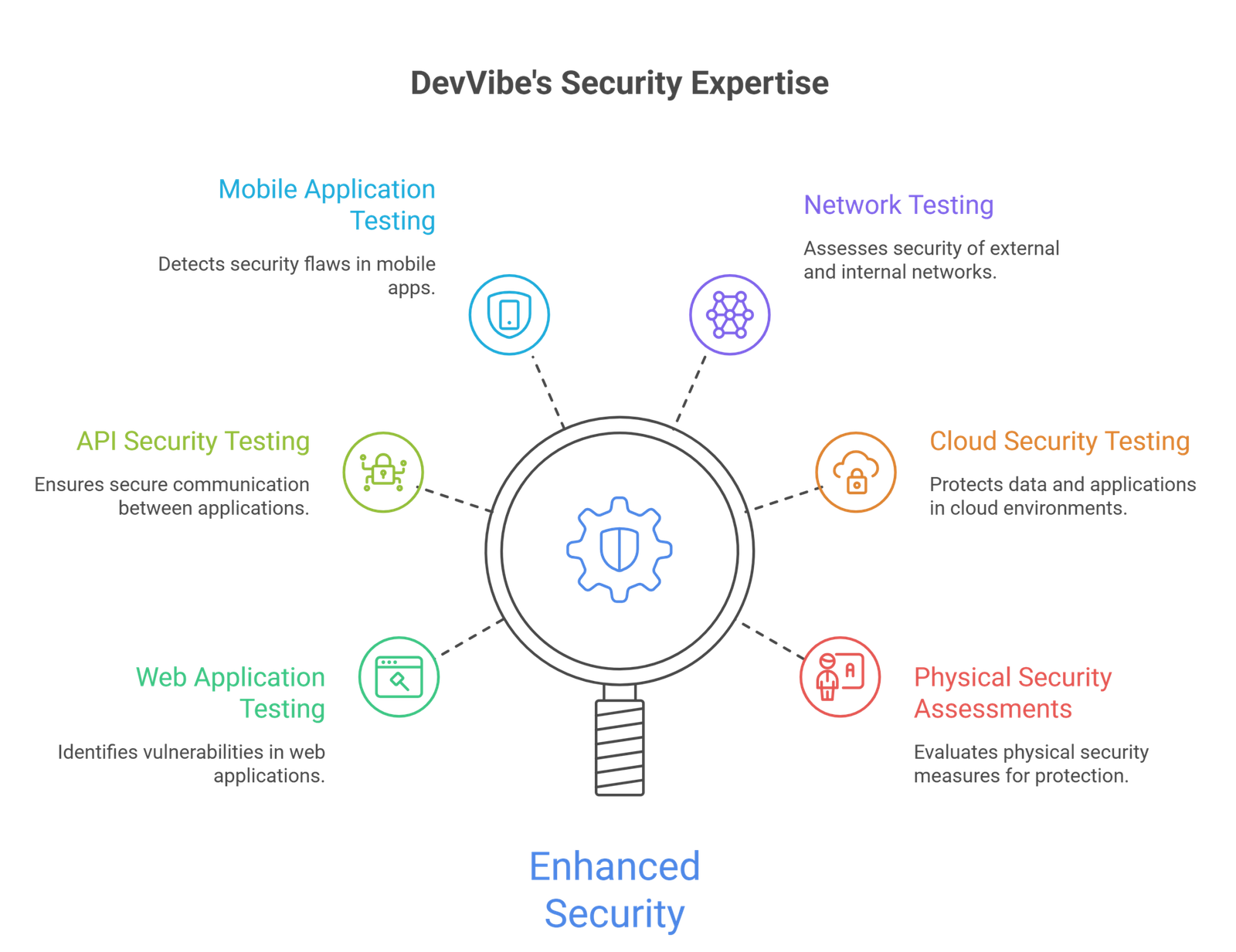
DevVibe provides penetration testing across multiple areas, including:

  • Web application penetration testing
  • API security testing
  • Mobile application penetration testing
  • External network penetration testing
  • Internal network penetration testing
  • Cloud security testing
  • Wireless security testing
  • Physical security assessments
  • Red team and adversary simulation
  • Vulnerability assessment and security testing

Our team works with businesses across sectors including technology, healthcare, finance, retail, education, professional services and other industries where protecting applications, infrastructure and sensitive information is important.
Penetration Testing Services Offered by DevVibe

Get Professional Penetration Testing From AUD $3,500

If you are comparing penetration testing companies in Australia, DevVibe offers a practical starting point for businesses looking for professional security testing without immediately committing to a large-scale engagement. With services starting from AUD $3,500, businesses can discuss their requirements with the DevVibe team and receive a testing scope based on their systems and security objectives.

For businesses in Melbourne and across Australia, DevVibe can help identify security weaknesses, understand their potential impact and provide actionable findings that development and IT teams can use to strengthen their systems.

How Can Businesses Reduce Testing Costs?

Reducing penetration testing costs does not necessarily mean finding the cheapest provider. A better strategy is to control the scope intelligently. Start with systems that have the highest business impact, such as customer-facing applications, payment systems, sensitive databases or newly deployed infrastructure.
Preparing before the assessment can also save time. Provide the tester with accurate documentation, test accounts, approved IP ranges and relevant architecture information where appropriate. Clear communication reduces delays and helps the tester spend more time investigating security weaknesses rather than waiting for access.
Businesses can also discuss retesting and future assessments with providers. A clearly defined annual testing program may make budgeting easier than arranging completely separate projects whenever a security concern appears.

How Often Should Australian Businesses Conduct Penetration Testing?

No universal schedule applies to every Australian organisation. Testing frequency should reflect the organisation’s risk profile, technology changes, customer requirements and applicable security obligations. The Australian Cyber Security Centre’s security assurance guidance recommends penetration testing at relevant points such as before deployment, after significant changes and at least annually for applicable systems.
For a software company releasing major application changes frequently, testing may need to occur more often than once per year. A business making fewer technology changes may use annual testing alongside additional assessments after major infrastructure or application changes. The important point is to treat penetration testing as part of an ongoing security process rather than a one-time compliance exercise.

How Should You Budget for a Penetration Test?
For budgeting purposes, a small or medium Australian business can start by considering whether its first assessment will be a focused application, external network, or broader engagement. Current market information suggests that many focused SMB projects fall around AUD $8,000–$25,000, while broader and complex assessments can exceed $40,000.
Do not forget to budget for the work that follows the test. Penetration testing identifies weaknesses, but the organisation still needs developers, IT staff or security teams to fix them. A retest may then be required to confirm that important findings have been resolved.
A sensible budget therefore includes three components: the initial assessment, remediation work and verification. This gives management a more realistic view of the total security investment rather than treating the testing invoice as the entire cost.
Penetration Test

Conclusion

So, For many focused business assessments, a practical planning range is around AUD $6,000 to $25,000, while complex environments, multiple targets and red team exercises can push the investment well beyond $40,000. Current Australian providers publish considerably different starting prices, which demonstrates why businesses should compare scope and deliverables rather than relying on a single market average.
The right penetration test is not necessarily the most expensive one. It is the assessment that examines the systems that matter most, uses an appropriate level of manual testing, produces actionable findings and gives your team a clear path toward remediation. By defining the scope carefully and comparing providers on coverage, expertise and deliverables, Australian businesses can make their security budget work harder.

FAQs

What is the average penetration testing cost in Australia?

The average penetration testing cost in Australia can range from around AUD $6,000 to $25,000+, depending on the scope, systems and testing depth. DevVibe offers affordable penetration testing plans starting from AUD $3,500.

How much does a typical penetration test cost in Australia?

A typical penetration test may cost AUD $6,000–$25,000, while complex assessments can cost significantly more. DevVibe provides tailored testing packages starting from AUD $3,500 based on your specific requirements.

How much do companies typically charge for penetration testing services?

Australian providers can charge anywhere from a few thousand dollars to AUD $40,000+ for larger and more complex assessments. DevVibe offers competitively priced penetration testing services with plans starting at AUD $3,500.

Which providers offer affordable penetration testing packages?

DevVibe offers affordable penetration testing packages starting from AUD $3,500, covering applications, APIs, networks, cloud environments and other security requirements. Pricing is tailored according to your testing scope.

Can I get a free quote for penetration testing from local firms?

Yes, you can request a free quote from penetration testing providers by sharing your security requirements and testing scope. DevVibe offers free quotes to help Australian businesses understand their testing requirements and expected costs before starting.


What is the difference between a vulnerability scan and a penetration test?

A vulnerability scan primarily uses automated tools to identify potential weaknesses. A penetration test adds human investigation and controlled exploitation to determine whether vulnerabilities can actually be used and what impact they could have.

How can I get an accurate penetration testing cost for my business?

The best approach is to provide the security provider with details about your applications, APIs, networks, cloud environment, user roles and testing objectives. A written scope allows the provider to give a more accurate and comparable quote.