Australia:
Building software used to mean spending weeks or months planning features, writing code, testing functionality and fixing bugs before you could even put an early version in front of customers.
AI is changing that process. With the rise of vibe coding, founders, marketers, product managers and even people without formal programming experience can describe what they want to build and use AI coding tools to generate working software.
This makes it much easier to turn an idea into an early prototype or Minimum Viable Product (MVP) without starting everything from scratch. But there is an important distinction between creating something that works and creating software that is secure, scalable, maintainable and ready for real customers.
That is where professional software development still matters.
What Is Vibe Coding?
Vibe coding is an AI-assisted approach to software development where you describe what you want to build in natural language and an AI coding tool generates or modifies the code for you.
Instead of manually writing every function, component or line of code, you can give an AI tool instructions such as:
“Build a customer dashboard where users can log in, view their orders and download invoices.”
The AI can then generate parts of the application based on your instructions.
You can continue refining the result by giving additional prompts:
- “Add a search function.”
- “Make the dashboard mobile-friendly.”
- “Add an admin panel.”
- “Connect the application to a database.”
- “Fix this error.”
- “Add user authentication.”
This conversational approach makes software experimentation considerably faster.
For Australian startups and businesses, it can be especially useful during idea validation and MVP development, where speed and experimentation often matter more than a fully polished product on day one.
How Does Vibe Coding Work?
The basic process is relatively straightforward.
1. Start With a Software Idea
First, define what you want to build.
This could be:
- A SaaS platform
- A mobile application
- An internal business system
- An AI chatbot
- A booking platform
- An e-commerce solution
- A customer portal
- An automation tool
You do not necessarily need a complete technical specification at this stage.
2. Describe Your Requirements to an AI Tool
You provide instructions using natural language.
For example:
“Create a web application for a fitness business where members can register, manage their memberships, book classes and receive reminders.”
The AI coding tool interprets your instructions and generates the required code.
3. Test the Generated Application
You then run the application and see whether it behaves as expected.
If something does not work, you can describe the problem to the AI and ask it to make changes.
4. Keep Refining the Product
You can progressively add features, improve the interface and change the functionality.
This creates a rapid build → test → improve cycle.
5. Move Towards a Proper MVP
Once you’ve validated the concept, the next step is turning the prototype into a reliable MVP.
This is where you need to look beyond simply generating code.
Architecture, security, databases, APIs, testing, performance and deployment all become increasingly important.
Why Is Vibe Coding Becoming Popular?
The biggest attraction of vibe coding is speed.
Traditionally, even a relatively simple software idea could require significant planning and development time before producing something users could actually interact with.
AI coding tools can dramatically shorten the distance between an idea and a working prototype.
The Australian Government’s current AIresources specifically discuss practical and responsible AI adoption for Australian businesses. AI adoption is also becoming more prominent across Australian businesses. Australian Government data reported that 41% of small and medium-sized enterprises were adopting AI in June 2025, highlighting the growing role of AI in business operations.
Faster Prototyping
A founder can demonstrate an early product concept without waiting for a lengthy development cycle.
Lower Barrier to Entry
People who understand their business problem but have limited coding knowledge can participate more directly in product development.
Easier Experimentation
Want to try a different dashboard?
Change the prompt.
Want to test another workflow?
Ask the AI to modify it.
This makes experimentation much cheaper and faster.
Better Communication Between Business and Technical Teams
AI-assisted development can also help business stakeholders communicate ideas more clearly.
Instead of explaining an abstract feature, they can describe what they want and quickly create a visual representation.
What Are AI Coding Tools?
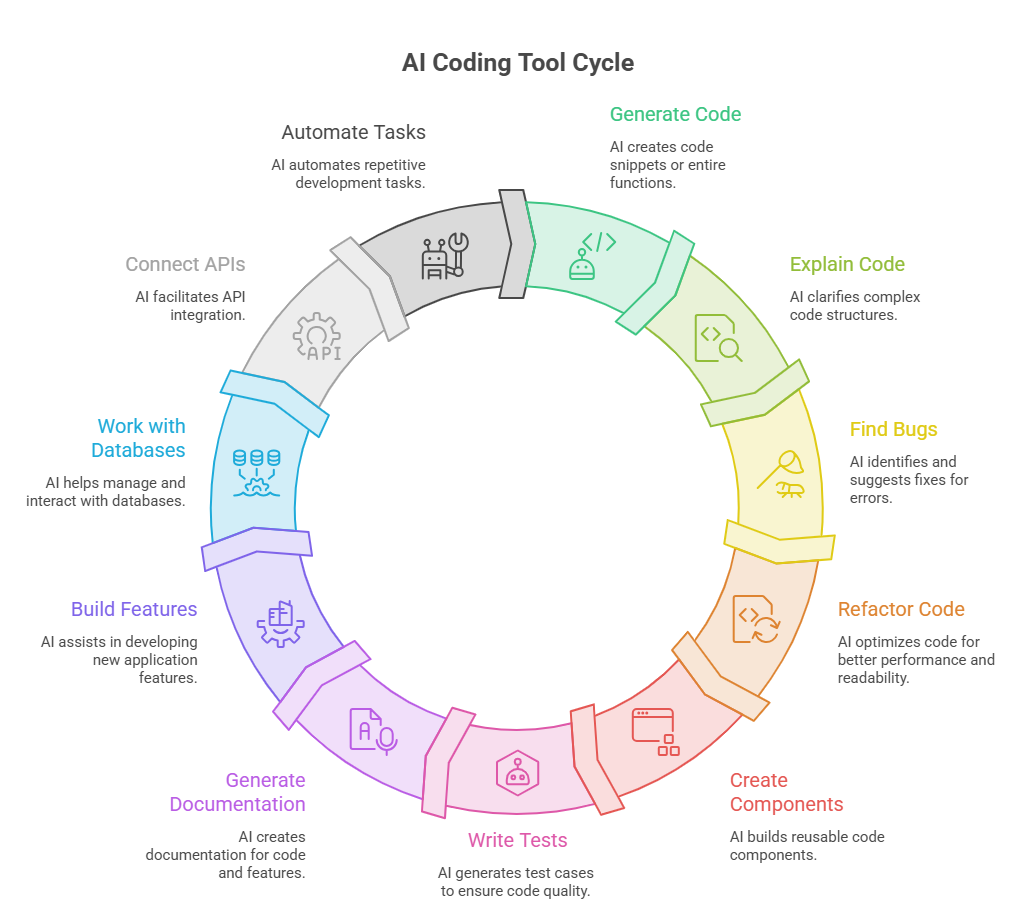
AI coding tools are software development tools that use artificial intelligence to assist with programming tasks.
Depending on the platform, they can help with:
- Generating code
- Explaining existing code
- Finding bugs
- Refactoring code
- Creating components
- Writing tests
- Generating documentation
- Building application features
- Working with databases
- Connecting APIs
- Automating repetitive development tasks
Some tools work inside traditional development environments, while others allow users to build applications primarily through natural-language instructions.
The important thing to understand is that AI coding tools are development assistants, not a replacement for software engineering expertise in every situation.
How AI Coding Tools Can Help You Build an MVP
An MVP tests whether a product idea solves a genuine problem for its intended users.
You do not necessarily need every feature on day one.
Instead, you need enough functionality to validate the core concept.
AI coding tools can help accelerate several parts of this process.
1. Turning an Idea Into a Prototype
One of the biggest advantages is moving from an idea to a working prototype quickly.
For example, an Australian startup might have an idea for a platform that helps small businesses automate customer enquiries.
Instead of spending months developing every possible feature, the team could begin with:
- User registration
- Customer dashboard
- AI chatbot
- Basic knowledge base
- Conversation history
- Admin controls
This gives the business something tangible to test with early users.
2. Building User Interfaces
AI can generate many common interface components, including:
- Login screens
- Dashboards
- Forms
- Navigation menus
- Tables
- Search interfaces
- Profile pages
- Admin panels
This can significantly speed up early UI development.
3. Creating Basic Backend Functionality
AI coding tools can also assist with backend functionality such as:
- API endpoints
- Database operations
- Authentication
- CRUD functionality
- Data validation
- Basic integrations
However, review generated backend code carefully before using it with real customer or business data.
4. Testing Different Product Ideas
Vibe coding makes it easier to create product variations and see which approach makes more sense.
This is valuable for startups because building the wrong product can be considerably more expensive than building the product itself.
Vibe Coding vs Traditional Software Development
Vibe coding and traditional development are not necessarily competitors.
In many cases, they work best together.
| Very fast prototyping | Structured development process |
| Natural-language instructions | Detailed technical planning |
| Excellent for experimentation | Better for complex systems |
| Lower barrier to entry | Requires technical expertise |
| Useful for early MVP concepts | Better suited to production software |
| Can produce inconsistent code | Stronger architecture and maintainability |
| AI-generated solutions need review | Engineering practices provide greater control |
The best approach often depends on what you are building and where the product is in its lifecycle.
For a simple prototype, vibe coding can be incredibly useful.
For a customer-facing platform handling sensitive information, payments, business-critical workflows or thousands of users, professional engineering becomes much more important.
What Are the Risks of Vibe Coding?
Vibe coding is powerful, but it is not magic.
AI-generated software can contain problems that are not immediately visible.
Security Vulnerabilities
Generated code may introduce security weaknesses if it has not been properly reviewed and tested.
This becomes particularly important when an application handles:
- Customer information
- Financial data
- Authentication credentials
- Business records
- Payment information
- Sensitive API keys
Poor Software Architecture
A prototype may work perfectly with a small amount of data but struggle when the number of users increases.
Without proper architecture, technical debt can accumulate quickly.
Bugs and Incorrect Logic
AI can generate code that looks convincing but does not behave correctly in every situation.
This is why testing and human review remain essential.
Scalability Problems
A system designed for 50 users may not automatically work efficiently for 50,000.
Production software needs to be designed with future growth in mind.
Maintenance Challenges
If an application is built through hundreds of disconnected AI prompts, the resulting codebase can become difficult for another developer to understand and maintain.
Can a Vibe-Coded MVP Become a Real Product?
Yes, absolutely.
A vibe-coded prototype does not need to be thrown away once you decide to build a serious product.
Instead, it can serve as a valuable starting point.
The important step is to assess the existing prototype and determine what needs to be:
- Refactored
- Rebuilt
- Secured
- Tested
- Optimised
- Documented
- Scaled
- Integrated with other systems
Think of the prototype as a proof of concept; the production-ready application is the engineered version of that concept.

From Vibe-Coded Prototype to Production-Ready MVP
This is where businesses often need professional development support.
A working prototype is only one part of building a successful software product.
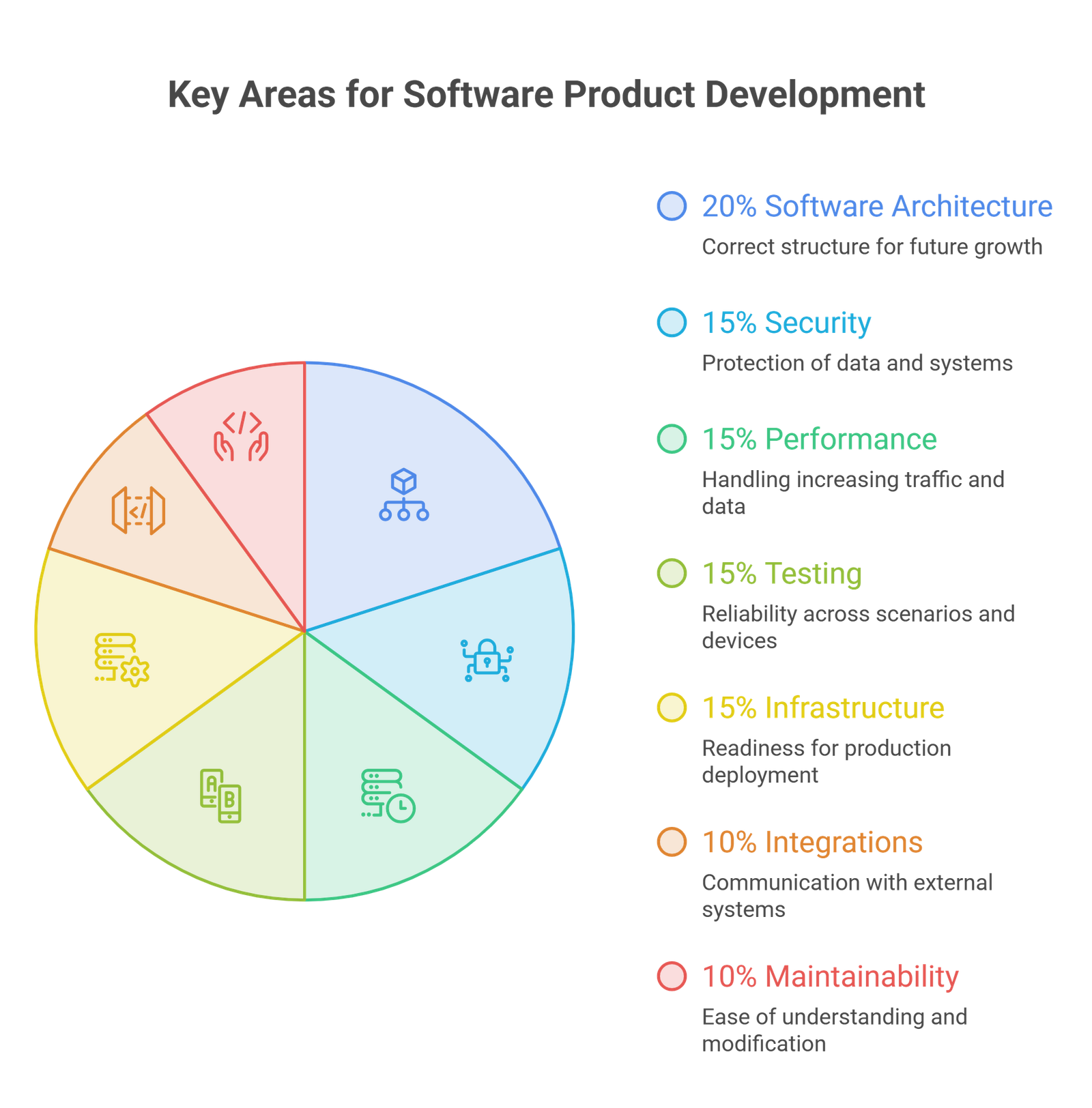
Before launching commercially, a development team should assess areas such as:
Software Architecture
Is the application structured correctly for future development and growth?
Security
Are authentication, authorisation, APIs, databases and user data properly protected?
Performance
Can the application handle increasing traffic and larger datasets?
Testing
Does the software work reliably across different scenarios and devices?
Infrastructure
Is the application ready for production deployment, monitoring, backups and ongoing maintenance?
Integrations
Can it reliably communicate with payment gateways, CRMs, third-party APIs, AI models and other business systems?
Maintainability
Can developers easily understand, modify and extend the codebase six months from now?
These questions can make the difference between an impressive prototype and a dependable business product.
How DevVibe Helps Turn AI Prototypes Into Scalable Products
For businesses experimenting with vibe coding, DevVibe can help bridge the gap between an early AI-generated prototype and a production-ready software product.
The team can work with an existing prototype, understand the underlying business requirements, and identify what needs improvement before commercial launch.
This can include:
- MVP development
- Custom web application development
- Mobile app development
- AI development and integration
- Software architecture
- API development and integrations
- Cybersecurity and penetration testing
- Cloud and deployment support
- Software optimisation
- Scaling existing applications
The goal is not simply to add more code.
It is to turn a promising concept into a reliable, secure and scalable product that can support real users and future business growth.
For an Australian startup or business, this approach can provide a practical path from idea → AI prototype → validated MVP → production software.
When Should You Move Beyond Vibe Coding?
Consider bringing in experienced developers when your application starts becoming business-critical.
Some clear signs include:
- You are preparing for a public launch.
- Your application will handle sensitive customer information.
- You need payment functionality.
- You expect significant user growth.
- You need complex third-party integrations.
- The codebase has become difficult to maintain.
- You are experiencing recurring bugs.
- You need stronger security.
- You require reliable cloud infrastructure.
- Investors or customers expect a production-ready product.
Vibe coding can get the engine started. Professional software engineering helps make sure the engine can survive the road ahead.
Is Vibe Coding the Future of Software Development?
Vibe coding is unlikely to eliminate traditional software development.
Instead, it is changing how software gets built.
Developers can use AI to handle repetitive coding tasks while spending more time on architecture, problem-solving, security, product decisions and complex engineering challenges.
For entrepreneurs and businesses, the biggest opportunity is even more interesting: the gap between having an idea and testing it with real users is shrinking.
That means businesses can experiment faster, validate concepts earlier and make better product decisions before committing significant resources.
The winning approach is not necessarily AI instead of developers.
It is often AI + experienced developers + strong product thinking.
Final Thoughts
Vibe coding has made software prototyping more accessible than ever. With the right AI coding tools, you can take a concept, generate an early application and start testing your MVP much faster than traditional development approaches might allow. But getting a prototype to work is only the beginning.
If your goal is to launch a serious commercial product, the next step is ensuring that the software is secure, scalable, maintainable and ready for real-world users.
That is where experienced software development teams can add significant value. Building software used to mean spending weeks or months planning features, writing code, testing functionality and fixing bugs before you could even put an early version in front of customers.