Australia:
If you are researching chatbot development cost in Australia, the first thing to understand is that there is no single fixed price. A simple website chatbot that answers a limited set of predefined questions is very different from an AI assistant that understands natural language, searches your company knowledge base, connects with a CRM, qualifies leads and hands complex conversations to human staff. Those differences can move a project from a relatively small development budget to a substantial custom software investment.
For Australian businesses in 2026, a practical starting range is around AUD $5,000 to $15,000 for a basic custom chatbot, AUD $15,000 to $40,000 for a more capable AI chatbot, and AUD $40,000 to $100,000+ for advanced enterprise conversational AI. These are planning ranges rather than official market prices because development agencies structure projects differently and the actual cost depends on requirements, integrations, AI architecture, security, testing and ongoing support. The Australian Bureau of Statistics reported that 12% of Australian businesses used AI in 2024–25, up from 1% in 2021–22, showing how quickly AI adoption is moving into mainstream business technology.
If your goal is to rank for chatbot development cost, the important question is therefore not simply, “How much does a chatbot cost?” It is, “What kind of chatbot does my Australian business actually need?” That distinction can save you thousands of dollars because you can avoid paying for advanced capabilities that your customers will never use while still leaving enough room for the chatbot to grow.
What Is the Average Chatbot Development Cost in Australia?
A chatbot development project usually includes several separate components: planning, conversational design, UI development, backend development, AI or NLP integration, database connectivity, third-party APIs, testing and deployment. A simple chatbot might require only a few of these components, while an enterprise assistant could require almost all of them. This is why two Australian businesses can receive completely different quotes for projects both described as “AI chatbot development.”
| Chatbot Australian development use case | ||
|---|---|---|
| Rule-based chatbot | AUD $3,000–$10,000 | FAQs and simple support |
| Basic AI chatbot | AUD $5,000–$15,000 | Website customer support |
| Custom AI chatbot | AUD $15,000–$40,000 | Support, sales and lead generation |
| AI chatbot with integrations | AUD $25,000–$60,000+ | CRM, ecommerce, booking and business systems |
| Advanced enterprise chatbot | AUD $40,000–$100,000+ | Internal knowledge, automation and complex workflows |
| Highly specialised AI assistant | AUD $100,000+ | Large-scale or highly regulated environments |
These figures should be treated as budgeting estimates, not guaranteed quotes. An Australian development company may charge on a fixed-project basis, hourly basis, dedicated-team basis or through an ongoing development agreement. The final figure can also change considerably when the chatbot needs to process confidential information, operate across multiple systems or support thousands of simultaneous users.
Chatbot Cost by Development Type
The cheapest chatbot option is generally a rule-based system. It follows predetermined conversation paths and works well when customers repeatedly ask the same limited questions. For example, a Melbourne service business might use one to answer questions about opening hours, service areas, appointment procedures and basic pricing.
AI-powered chatbots are different because they can interpret natural-language questions and generate or retrieve more flexible responses. When you add a knowledge base, retrieval-augmented generation, CRM integration, authentication, analytics and human handover, development becomes more involved. At that point, the chatbot development cost is influenced less by the chat window itself and more by the software ecosystem sitting behind it.
What Determines Chatbot Development Cost?
The easiest way to understand chatbot pricing is to imagine that the chatbot is the visible tip of an iceberg. Customers see a conversation box, but underneath it may be an AI model, application server, database, authentication system, analytics layer, APIs, business rules and security controls.
The first major cost driver is complexity. A chatbot answering ten FAQs requires much less engineering than one that checks inventory, creates a customer record, retrieves an order, books an appointment and sends information into a CRM. The second driver is integration. Connecting an AI assistant to existing software often requires API development, authentication, error handling and extensive testing.
Data quality also matters. If a chatbot needs to answer questions based on company documents, product catalogues, policies or internal knowledge, developers need to determine how that information will be collected, structured, indexed, retrieved and updated. A chatbot is only as useful as the information and workflows behind it, so businesses should budget for data preparation rather than treating it as an afterthought.
Chatbot Features and Functionality
Features can significantly change your development budget. A chatbot with a branded interface and a small FAQ database may be straightforward, while a sophisticated conversational assistant can include dozens of interconnected functions.
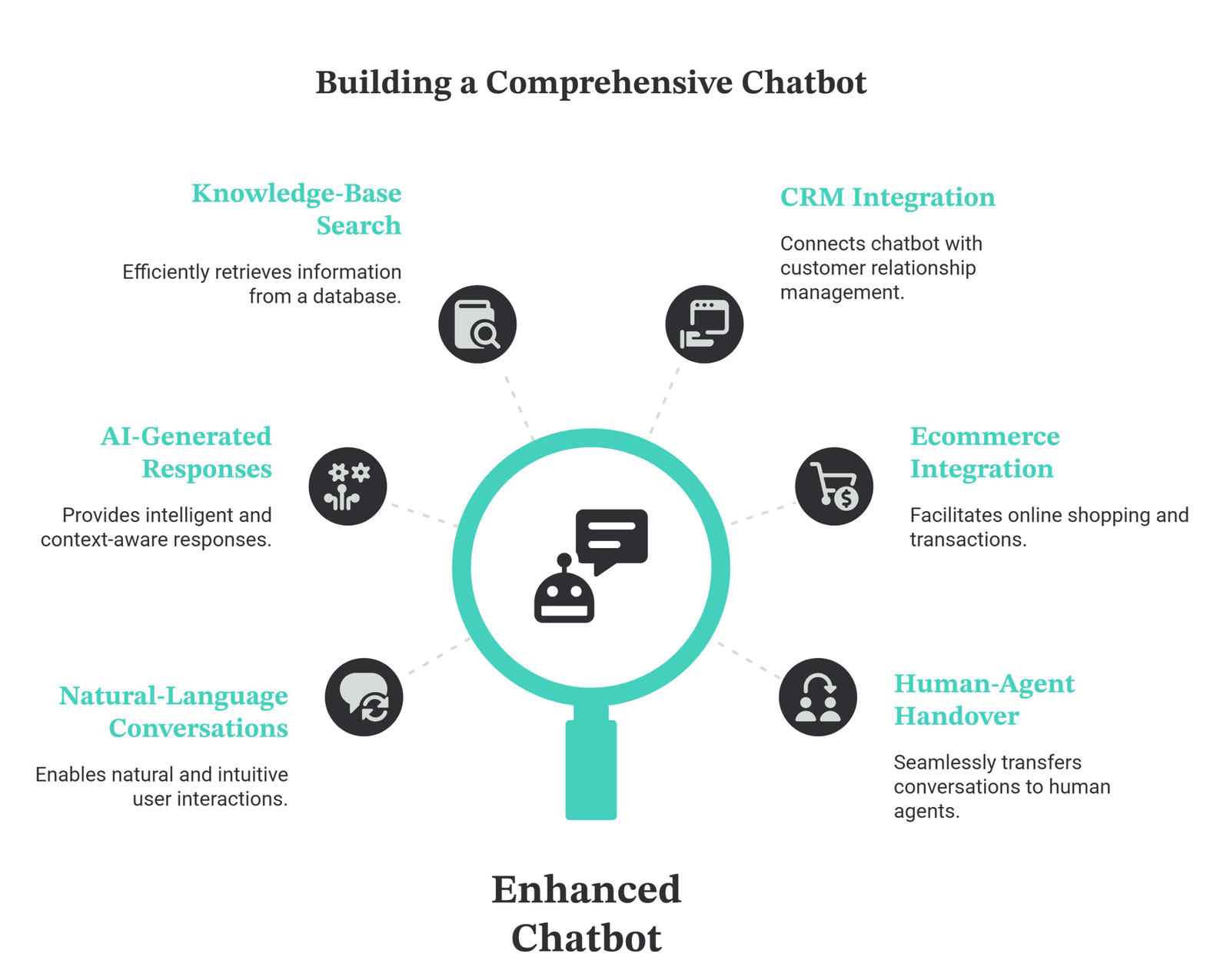
Common features include:
- Natural-language conversations
- AI-generated responses
- Knowledge-base search
- Lead qualification
- CRM integration
- Ecommerce integration
- Appointment booking
- Human-agent handover
- Customer authentication
- Multilingual support
- Voice capabilities
- Analytics and reporting
- Admin dashboards
- Conversation history
- Role-based access
- Automated workflow actions
You do not necessarily need all of these features. In fact, starting with a focused use case can make the project easier to launch and measure. Once the chatbot proves its value, additional functionality can be introduced based on real customer behaviour instead of assumptions.
AI Model and Technology Stack
The underlying technology also influences chatbot development cost. Developers can use commercial large language models through APIs, open-source models, smaller specialised models or combinations of different technologies. Each approach has different implications for development, hosting, performance, privacy and ongoing operating costs.
A business chatbot may also require technologies such as vector databases, retrieval systems, orchestration frameworks, cloud infrastructure and monitoring tools. DevVibe, for example, lists technologies including LangChain, FastAPI, Docker, Kubernetes and MLflow within its AI development technology stack.
The right architecture depends on the use case. There is little value in building an unnecessarily complicated AI system for a chatbot whose only job is answering a dozen common questions. Conversely, using an overly basic setup for a business-critical assistant can create limitations later.
Custom AI Chatbot vs Basic Rule-Based Chatbot
A rule-based chatbot behaves like a decision tree. The user selects or enters something, the system matches it to predefined logic, and the conversation follows a controlled path. This approach can be useful when the questions and answers are predictable.
A generative AI chatbot works more like a conversational assistant. Instead of requiring every possible sentence to be programmed, it can interpret different ways of asking a question and produce an appropriate response. With a properly designed knowledge retrieval system, it can also use business information as context.
| Factor | Rule-based chatbot | AI chatbot |
|---|---|---|
| Development complexity | Lower | Higher |
| Initial cost | Lower | Higher |
| Natural conversation | Limited | Stronger |
| Flexible questions | Limited | Much broader |
| Business knowledge | Predefined | Can use knowledge retrieval |
| Integrations | Possible | Possible |
| Maintenance | Rule updates | Model, data and system monitoring |
| Best for | Simple workflows | Support, sales and complex assistance |
The important point is that more expensive does not automatically mean better. The correct technology is the one that matches the business problem. A restaurant answering booking FAQs may not need an expensive enterprise AI platform, while a financial or professional-services organisation handling complex customer questions may need a much more controlled architecture.
Chatbot Development Cost by Business Size
Small businesses usually need a chatbot that solves one or two clear problems. This might mean answering customer questions, collecting leads, providing product information or directing visitors to the correct service. Such projects can often be developed without building a large custom AI platform.
A growing company may need deeper integrations. For example, an ecommerce company could connect the chatbot with product information, order status, customer accounts and support workflows. That requires more backend engineering and security considerations.
Large organisations often have completely different requirements. They may need multiple departments, permissions, analytics, enterprise authentication, knowledge sources, auditability and integration with internal systems. The chatbot becomes part of the organisation’s technology infrastructure rather than simply being a widget added to a website.
Small Business Chatbot
For an Australian small business, a realistic initial budget might sit around AUD $5,000–$15,000 for a custom chatbot with a defined scope. The project could include website integration, a branded interface, an AI model, business FAQs, lead capture and basic analytics.
The best way to control the chatbot development cost is to avoid building everything at once. Start with the conversations that create the greatest operational value. Once customers are actually using the system, analytics can show which questions require better responses and which additional integrations would be worthwhile.
Enterprise AI Chatbot
Enterprise chatbot projects can move beyond AUD $40,000 and potentially exceed AUD $100,000, depending on requirements. At this level, the project may include several business systems, internal knowledge repositories, security controls, advanced monitoring, multiple user roles and extensive testing.
The cost isn’t simply paying for “a smarter chatbot.” You are paying for a production-grade software system that must reliably interact with other systems and handle real business data.
Cost of Chatbot Integrations in Australia
Integrations are one of the most underestimated parts of chatbot development. Connecting a chatbot to a CRM, ERP, ecommerce platform, booking system, helpdesk or custom database can require significant backend work.
For example, imagine a customer asking, “Where is my order?” A simple chatbot can respond with a generic support article. An integrated chatbot needs to identify the customer, securely access the order system, retrieve the correct record and return the information without exposing another customer’s data.
This is where development estimates can change quickly. Each integration introduces authentication, API handling, permissions, error scenarios and testing. Businesses should therefore ask developers to separate core chatbot development costs from integration costs in their proposal.
Ongoing Chatbot Maintenance and AI Costs
Launching the chatbot is not the end of the budget. There are ongoing expenses associated with hosting, AI model usage, monitoring, software updates, security patches, analytics and content maintenance.
AI API usage can also vary according to traffic and conversation length. A chatbot receiving a few hundred conversations per month will have a very different usage profile from one handling tens of thousands of conversations.
A useful maintenance budget can therefore include:
- Cloud hosting
- AI model/API consumption
- Database or vector-storage costs
- Security monitoring
- Software updates
- Knowledge-base updates
- Performance monitoring
- Conversation review
- Bug fixes
- Feature improvements
A chatbot that gives incorrect information can damage customer trust, so monitoring should not be treated as optional. The Australian privacy regulator, OAIC, also highlights that AI systems can produce inaccurate or false results and recommends organisations consider appropriate safeguards and accuracy controls.
Australian Privacy and AI Compliance Considerations
Australian businesses need to think carefully about privacy when developing AI chatbots. This becomes particularly important when a chatbot collects names, email addresses, phone numbers, customer histories, health information, financial information or other personal data.
The Office of the Australian Information Commissioner (OAIC) states that privacy obligations apply to personal information entered into AI systems and to AI-generated outputs where they contain personal information. It also advises organisations to conduct due diligence, consider security and privacy risks, maintain appropriate human oversight and clearly identify public-facing AI tools such as chatbots.
This means privacy should influence the architecture from the beginning. Developers should consider what information the chatbot collects, where it is stored, who can access it, whether information crosses borders and how long it is retained. The OAIC also recommends that organisations do not enter personal or particularly sensitive information into publicly available generative AI tools because of the associated privacy risks.
For Australian businesses, responsible AI design is therefore part of the development budget, not an optional extra.
How Long Does It Take to Build a Chatbot?
Development time depends heavily on scope. A basic chatbot may take a few weeks, while a custom AI assistant with several integrations can take several months.
| Project type | Approximate development time |
|---|---|
| Basic FAQ chatbot | 2–4 weeks |
| AI website chatbot | 3–8 weeks |
| Custom AI chatbot | 6–12 weeks |
| AI chatbot with multiple integrations | 8–16+ weeks |
| Enterprise conversational AI | 3–6+ months |
These are planning estimates rather than fixed schedules. Requirements, content availability, approval processes and third-party APIs can all affect delivery time.
A practical approach is to develop an MVP first. Instead of spending months building every possible feature, launch a useful first version, measure real usage and then expand it.
How to Reduce Chatbot Development Costs
Reducing chatbot development cost does not necessarily mean hiring the cheapest developer. A poorly designed chatbot can become more expensive because you eventually have to rebuild it.
Start by writing down the exact business problem. Is the chatbot intended to reduce support tickets, capture leads, help customers choose products, automate internal questions or complete transactions? Once that objective is clear, unnecessary functionality becomes easier to remove.
Another useful approach is to use existing AI models through APIs rather than developing a proprietary language model from scratch. For most businesses, building an entire foundational model would be unnecessary. A custom application built around an existing model can deliver useful functionality at a much more practical development cost.
You can also reduce expenses by preparing your content before development begins. Clean FAQs, product data, documentation and customer-service policies allow developers to spend less time cleaning and organising information.
Choosing a Chatbot Development Company in Australia
The cheapest quote is not necessarily the lowest-cost solution. When comparing developers, look at how clearly they understand your business requirements, architecture, integrations, security and long-term maintenance.
Ask potential development partners to explain what is included in their quote. Does it include UI/UX design? AI integration? Knowledge-base setup? Testing? Deployment? Analytics? Post-launch support? API costs?
For Australian companies, local availability can also make communication easier. DevVibe has an Australian presence in Tarneit, Victoria, and provides AI development services including natural-language processing and AI chatbot development.
You can also review a company’s broader AI development services to see whether chatbot development is part of a wider technical capability rather than a standalone service.
Chatbot Development Cost: DIY vs Outsourcing
Building a chatbot internally can make sense when your organisation already has developers, AI expertise and infrastructure. However, the apparent saving can disappear when you account for engineering time, architecture decisions, security, testing, deployment and maintenance.
Outsourcing gives you access to specialists without necessarily hiring a permanent AI engineering team. A development company can handle the architecture, frontend, backend, AI integration, testing and deployment while your internal team focuses on the business requirements.
For companies that need a more extensive software ecosystem, chatbot development may also form part of a broader custom software development project.
Is a Custom Chatbot Worth the Investment?
The answer depends on the business case rather than the technology itself. If your support team spends hundreds of hours answering repetitive questions, a chatbot may automate a meaningful portion of that workload. If your sales team receives many repetitive product enquiries, the chatbot can potentially handle initial qualification and route high-value leads to employees.
The Australian Government has reported increasing business adoption of AI. An AI Adoption Tracker released in 2025 reported that 41% of small and medium-sized enterprises were adopting AI, while surveyed businesses reported improvements in areas including decision-making speed and productivity.
The business case should therefore be measured through specific metrics: support hours saved, leads generated, conversion rate, response time, customer satisfaction and cost per conversation. Those numbers tell you whether the chatbot is creating value.
Why Australian Businesses Are Investing in AI Chatbots
Australian businesses operate in a market where customers increasingly expect fast digital communication. People don’t necessarily want to wait for business hours to ask a simple question about pricing, availability, delivery or service options.
AI chatbots can provide an always-available communication layer. They can handle common enquiries while human employees focus on conversations requiring judgement, empathy or specialist expertise.
The broader AI trend is also becoming more visible in Australian business data. According to the ABS, 12% of businesses used AI during 2024–25, with adoption reaching 37% among large businesses that reported AI use.
That does not mean every business needs an AI chatbot. It does show why conversational AI is becoming a practical business technology rather than simply an experimental feature.
Chatbot Development Cost in Melbourne
If your business is based in Melbourne, local development support can be particularly useful when the chatbot needs to integrate with existing operations or requires regular strategy meetings. Melbourne businesses range from professional services and retail companies to technology, education, healthcare and property organisations, each with different conversational requirements.
For a Melbourne business, the chatbot development cost may be influenced by the same technical factors found elsewhere in Australia: project complexity, AI model, integrations, data requirements, security and ongoing support. The location itself does not automatically determine the technology cost.
DevVibe has an Australian office in Tarneit, VIC 3029, and its AI development offering includes chatbot development, NLP, automation and machine-learning solutions.
If you are evaluating a Melbourne project, you can also use DevVibe’s contact page to discuss requirements and request a project proposal.
How DevVibe Builds AI Chatbots for Australian Businesses
DevVibe approaches chatbot projects as broader software and AI solutions rather than simply placing a chat widget on a website. Its Australian AI service covers machine learning, deep learning, natural-language processing, robotic process automation and AI chatbot development.
The development process can include understanding the business problem, preparing relevant data, designing the AI architecture, developing the application, connecting required systems, testing performance and deploying the final solution. This matters because a chatbot needs to fit into the way employees and customers actually work.
For businesses looking beyond a chatbot, DevVibe also provides wider software and AI capabilities. Its website describes solutions spanning AI development, application development, software development, SaaS/MVP development, robotics and cloud/ERP services.
That broader capability can be useful when a chatbot eventually needs to become part of a larger customer portal, ecommerce system, internal platform or automation workflow.
Factors to Discuss Before Getting a Chatbot Quote
Before asking a developer for a fixed price, prepare a short project brief. You don’t need a technical document. A clear explanation of your customers, business problem and desired outcome is usually enough to start the discussion.
Your brief should answer:
- Who will use the chatbot?
- What questions should it answer?
- Should it use your internal documents or database?
- Does it need CRM or ERP integration?
- Should it collect customer information?
- Does it need customer authentication?
- Should conversations be transferred to human staff?
- How many users do you expect?
- What channels will it support?
- What does success look like?
These answers allow developers to estimate the chatbot development cost more accurately. They also prevent vague proposals where one company quotes for a simple chatbot while another quotes for a complete AI platform.
Chatbot Development Cost Checklist
| Cost factorWhy it matters | |
|---|---|
| Chatbot type | Determines architecture and complexity |
| AI model | Influences capabilities and API usage |
| Number of integrations | Adds backend development and testing |
| Data preparation | Affects knowledge retrieval quality |
| UI/UX | Determines frontend design effort |
| Security | Important when handling business/customer data |
| Hosting | Creates ongoing infrastructure expenses |
| AI usage | Can vary with conversation volume |
| Maintenance | Keeps the chatbot accurate and reliable |
| Analytics | Helps measure business performance |
Conclusion
The chatbot development can range from several thousand dollars for a focused chatbot to more than AUD $100,000 for a sophisticated enterprise conversational AI platform. A realistic planning range for many businesses is around AUD $5,000–$40,000, while advanced integrations, security requirements, complex workflows and enterprise-scale deployments can push the investment significantly higher.
The right budget depends on what you want the chatbot to accomplish. A simple FAQ assistant does not need the same architecture as an AI sales assistant connected to a CRM, ecommerce platform and customer database. Start with the business problem, define the conversations that matter, identify required integrations and then select the technology.
For Australian businesses, privacy and responsible AI design should also be considered from the beginning. The OAIC’s guidance makes clear that organisations need to consider privacy, transparency, accuracy, security and human oversight when AI systems process personal information.
If you are planning an AI chatbot for a Melbourne or wider Australian business, a detailed technical discovery is usually the best starting point. You can explore DevVibe’s AI development services or contact DevVibe for a project estimate to define the scope and obtain a tailored estimate.
FAQs About Chatbot Development Cost in Australia
1. How much does chatbot development cost in Australia?
A basic custom chatbot can start around AUD $5,000, while more advanced AI chatbot projects commonly move into the AUD $15,000–$40,000+ range. Enterprise solutions with multiple integrations, advanced security and complex workflows can exceed AUD $100,000.
2. What is the biggest factor affecting chatbot development cost?
The biggest factor is usually project complexity. Integrations, AI functionality, custom knowledge bases, authentication, automation workflows and security requirements can significantly increase development time and cost.
3. How much does an AI chatbot cost for a small Australian business?
A small Australian business may budget approximately AUD $5,000–$15,000 for a focused AI chatbot. The final price depends on the required features, AI model, content, integrations and deployment requirements.
4. How long does it take to develop an AI chatbot?
A basic chatbot may take 2–4 weeks, while a custom AI chatbot can take 6–12 weeks. Enterprise conversational AI systems with several integrations can require several months.
5. Can DevVibe develop an AI chatbot in Melbourne?
Yes. DevVibe has an Australian presence in Tarneit, Victoria, and its Australian AI development service includes AI chatbot development, natural-language processing, machine learning and automation.