Australia:

Introduction
CPS 234 is no longer a new requirement that Australian financial institutions are preparing to adopt. It has become an established information security standard that APRA expects regulated organisations to follow. In 2026, its importance is even more apparent because it operates alongside another major regulatory standard.
APRA’s CPS 230 Operational Risk Management came into effect on 1 July 2025, with targeted amendments commencing on 1 July 2026. While CPS 230 focuses on critical operations, business continuity and material service providers, it does not replace CPS 234. Both standards work alongside each other, giving APRA a broader view of an organisation’s security arrangements, operational resilience and supplier relationships.
For Australian business leaders reviewing their CPS 234 obligations, this is an important distinction. The main concern is no longer simply whether the standard applies. Organisations must be able to demonstrate that their security capabilities, controls and third-party arrangements are effective and supported by reliable evidence.
This guide explains what CPS 234 means, which organisations must comply, the challenges it addresses, its key benefits and requirements, and how businesses can approach implementation. It also explores the role of technology, security testing, industry-specific requirements and the process of selecting a suitable compliance provider.
Problem / Challenges
Why CPS 234 Creates Challenges for Australian Businesses
Most Australian organisations already have some form of information security policy. However, having a policy in place does not necessarily demonstrate that the organisation is meeting CPS 234 requirements.
The real challenge is proving that security measures are implemented, regularly tested and suitable for the information assets they are intended to protect.
Some common gaps include:
- Incomplete information asset registers. An organisation cannot properly protect assets it has not identified. Without a complete record of information assets, including those managed by external providers, it becomes difficult to classify information, assign ownership and introduce appropriate security controls.
- Security policies without practical evidence. A policy may state that sensitive information is encrypted, but this alone does not demonstrate that encryption is consistently applied. CPS 234 expects organisations to implement their controls, test them and maintain evidence of their effectiveness.
- Limited visibility into third-party security. Cloud platforms, outsourced IT providers, payroll systems, claims processing services and customer management platforms may all handle important organisational information. If their security arrangements are not assessed, included in contracts and monitored regularly, they can introduce risks that the regulated organisation still needs to manage.
- Lack of incident response preparation. When a material information security incident occurs, an organisation has a limited timeframe to assess its significance, determine reporting responsibilities and notify APRA. Without a properly rehearsed response process, teams may struggle to make decisions quickly, particularly when evidence and system logs are incomplete.
- Testing that does not demonstrate ongoing effectiveness. Conducting a penetration test once a year does not automatically prove that security controls remain effective throughout the year. CPS 234 requires a systematic, risk-based approach to testing, with identified weaknesses recorded and addressed.
- Insufficient reporting to the board. If directors receive only general statements such as “the organisation is compliant”, without information about control effectiveness, security weaknesses or third-party risks, they may not have the evidence needed to fulfil their responsibilities under CPS 234.
Consider your organisation’s current position. If APRA requested your information asset register, recent control testing reports and third-party security assessments tomorrow, could your team provide them promptly? Or would it need to create much of that documentation from scratch?
The solution is not necessarily to purchase more security tools. Businesses need a structured CPS 234 programme built around clear asset ownership, appropriate controls, regular testing, documented evidence and an incident notification process that employees have practised.
Do not wait for a security incident to expose weaknesses in your compliance arrangements. Arrange a CPS 234 gap assessment for your Australian business through DevVibe’s scoping call.

The Cost of Ignoring CPS 234
Taking no action does not eliminate information security risks. It simply leaves an organisation less prepared to demonstrate that those risks are being managed.
A security breach involving an APRA-regulated entity can lead to customer harm, regulatory scrutiny, licence conditions, remediation requirements and potentially higher capital requirements. For a third-party provider, failing to meet a regulated client’s security expectations could result in contract termination or the loss of future business.
In either situation, responding to compliance gaps after an incident can be considerably more expensive than addressing them through a planned programme. The financial impact is only part of the problem. Damage to customer confidence and business reputation can continue long after the incident has been resolved.
Definition or Explanation of the Topic
What Is CPS 234?
CPS 234 refers to Prudential Standard CPS 234 Information Security, introduced by the Australian Prudential Regulation Authority (APRA). It establishes mandatory information security requirements for APRA-regulated organisations across Australia.
The standard requires regulated entities to maintain information security capabilities that are appropriate for the size and extent of threats to their information assets.
This principle is central to CPS 234. It means an organisation must understand what information it holds, identify the threats that could affect it and implement security measures that reflect the level of risk. Compliance is not simply about preparing documents or completing a checklist once. It requires an ongoing approach supported by evidence.
CPS 234 has applied since 1 July 2019. For information assets managed by third parties, the requirements applied from the earlier of the next contract renewal or 1 July 2020.
Who Must Comply With CPS 234?
CPS 234 applies to APRA-regulated entities across several areas of Australia’s financial services industry. These include:
- Authorised deposit-taking institutions (ADIs): Banks, credit unions and building societies, including foreign ADIs operating in Australia.
- General insurers: General insurance businesses, including Category C insurers.
- Life companies: Organisations providing life insurance products and services.
- Private health insurers: Insurers registered under the PHIPS Act.
- Registrable Superannuation Entity (RSE) licensees: Superannuation trustees, in relation to their business operations.
- Authorised non-operating holding companies (NOHCs): Holding companies operating within the relevant regulated sectors.
Third-party service providers are not directly regulated by APRA simply because they work with a regulated organisation. However, CPS 234 requirements extend to information assets managed by those providers on behalf of regulated entities.
As a result, regulated organisations need to assess their vendors, establish appropriate contractual security requirements and monitor their performance. Service providers must also be prepared to demonstrate that their security arrangements meet their clients’ expectations.
If your business is not directly regulated by APRA, such as a fintech startup, non-bank lender or self-managed super fund, CPS 234 may not apply to you directly. However, your position could be different if you provide services to a regulated organisation or manage its information assets.
In that situation, clients may require you to demonstrate CPS 234 readiness through contracts, security assessments, audits and due diligence processes.
CPS 234 vs ISO 27001 vs Essential Eight
CPS 234, ISO 27001, Essential Eight and CPS 230 all relate to security or operational risk, but they serve different purposes. Understanding these differences helps organisations avoid assuming that compliance with one framework automatically satisfies another.
| Framework | What It Is | How It Relates to CPS 234 |
|---|---|---|
| CPS 234 | APRA’s mandatory prudential standard for regulated entities. | The primary regulatory obligation. It includes board accountability, a principles-based approach and incident notification requirements. |
| ISO 27001 | An international standard for information security management systems. | Provides a strong foundation for information security management, but certification alone does not fulfil every CPS 234 requirement. |
| Essential Eight | A set of mitigation strategies developed by the Australian Cyber Security Centre. | Offers practical security controls but does not replace CPS 234’s requirements for security capability, testing and notification. |
| CPS 230 | APRA’s operational risk management standard, effective from 1 July 2025. | Complements CPS 234 by addressing critical operations, business continuity and material service providers. |
One important point is that an organisation cannot assume it meets CPS 234 simply because it has passed an ISO 27001 audit. ISO 27001 can help establish a structured information security management system, but CPS 234 also requires organisations to demonstrate clear accountability, maintain information asset records, test controls and meet APRA’s notification obligations.
What Do CPS 234 Compliance Services Include?
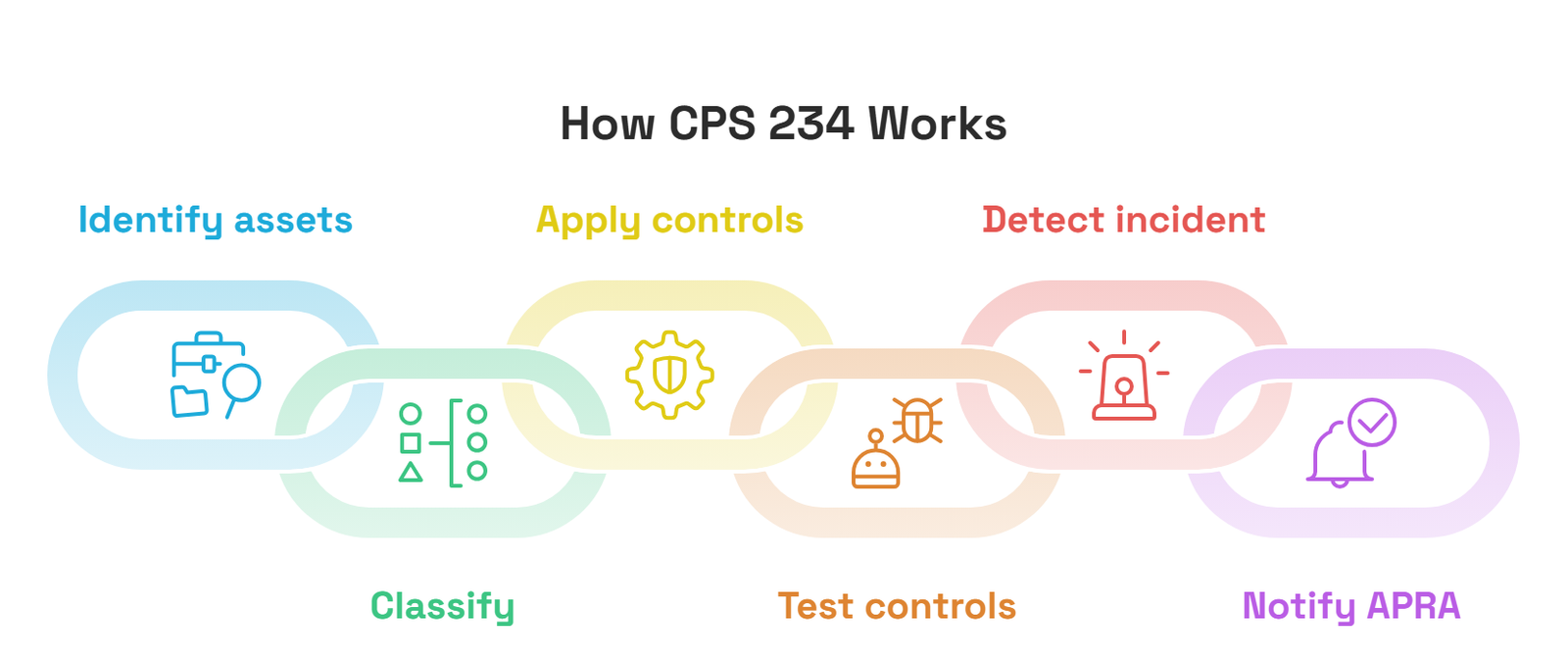
A comprehensive CPS 234 compliance service should address the organisation’s actual security arrangements rather than focus only on policy documents.
Typical services include:
- A CPS 234 gap assessment supported by evidence and a prioritised list of compliance weaknesses.
- Identification and classification of information assets, including the assignment of responsible owners.
- Review and improvement of security policies, with clear responsibilities for the board and management.
- Design and implementation of controls that reflect the importance and sensitivity of each asset.
- Security assessments of third parties and vendors, including contractual requirements and ongoing monitoring.
- Regular security testing, including vulnerability assessments, penetration testing and control effectiveness reviews.
- Incident response planning and practical rehearsals covering the 72-hour and 10-business-day notification requirements.
- Internal audit assistance and board reporting that presents actual evidence of security performance.
Also Read: Penetration Testing in Australia to understand how testing can help demonstrate the effectiveness of your controls. You can also explore DevVibe’s cyber security services for broader security requirements.
Why the Topic Matters
Why CPS 234 Matters in Australia in 2026
In 2026, Australian financial organisations need to move beyond simply maintaining security policies. They must be able to demonstrate that their controls work and that their information security arrangements are regularly reviewed.
Several developments make CPS 234 particularly important.
- APRA expects evidence of compliance. Since the standard came into effect, APRA has continued to monitor how regulated organisations manage their information security responsibilities. A policy that exists only on paper does not demonstrate that the organisation has effective security controls.
- CPS 230 increases the focus on suppliers. Effective from 1 July 2025, CPS 230 requires organisations to manage operational risks, critical operations and material service providers. This makes supplier oversight an important part of the broader compliance picture.
- Third-party relationships introduce additional security risks. Organisations increasingly depend on cloud platforms, outsourced services and external technology providers. CPS 234 addresses this by including information assets managed by third parties within its scope.
Ultimately, successful organisations in 2026 will be those that can provide meaningful evidence when APRA, an auditor or a regulated client requests it. This may include an up-to-date asset register, recent security testing results, vendor assessments and a rehearsed incident response process.

Key Benefits
1. Demonstrate Security With Evidence
CPS 234 encourages organisations to maintain documented evidence of their information assets, responsible owners, security controls, testing activities and incident records.
This evidence can support regulatory reviews, internal audits, insurance assessments and security checks conducted by regulated clients before entering into business agreements.
2. Identify Security Risks Before They Become Incidents
A structured approach to asset classification and control testing helps organisations identify weaknesses that may not be visible through a basic policy review.
For example, a business may discover an unregistered system, a security control that has never been tested or a third-party provider with extensive access but insufficient security oversight.
Identifying these issues early gives the organisation an opportunity to address them before they develop into serious incidents.
3. Improve Incident Response
A well-prepared incident response process helps employees understand what to do when a material security incident occurs.
With a rehearsed 72-hour notification process, the organisation can focus on investigating the incident, containing the threat and collecting relevant evidence rather than spending valuable time deciding who is responsible for reporting it.
4. Maintain Existing Contracts and Attract New Clients
For businesses providing services to banks, insurers and superannuation funds, CPS 234 readiness can influence commercial relationships.
Regulated clients need confidence that their service providers can protect the information assets they manage. Businesses that can demonstrate suitable security arrangements may be better positioned to retain existing contracts and compete for new opportunities.
5. Direct Security Investment Towards Important Assets
CPS 234 follows a proportionate approach. Security capabilities should reflect the threats and importance of an organisation’s information assets.
This allows businesses to prioritise critical and sensitive systems rather than applying the same level of investment to every asset, regardless of its risk.
Noticeable CPS 234 Compliance Provider in Australia
If your organisation is comparing CPS 234 compliance providers in Australia, DevVibe offers an evidence-focused approach for businesses that need more than a collection of policies and templates.
DevVibe positions itself as a leading CPS 234 compliance provider in Australia, helping organisations assess their security arrangements, address gaps and establish practical compliance processes.
Here are some of the reasons businesses may consider DevVibe:
- Evidence-based assessments: DevVibe assesses information assets, security controls, testing records and third-party arrangements against CPS 234 requirements. The aim is to identify specific weaknesses and provide supporting evidence rather than rely on generic checklists.
- Solutions designed around your technology: Security arrangements are considered in the context of your existing systems, cloud infrastructure, vendors and information assets. This helps ensure that recommended controls are relevant to the environment in which your business operates.
- Clear governance and accountability: Board responsibilities, management duties and individual ownership are defined in straightforward language. Reporting can highlight existing controls, identified weaknesses and the progress of remediation activities.
- Testing and remediation: Vulnerability assessments, penetration testing and control testing can help identify security weaknesses. Findings are documented and tracked so that the organisation can work towards resolving them.
- Third-party risk management: Vendor assessments, contractual security requirements and ongoing monitoring are included in the approach, covering relevant cloud and offshore service providers.
- Ownership of deliverables: Asset registers, policies, test results, logs and remediation plans are handed over to the client. The objective is to provide useful documentation and avoid unnecessary vendor lock-in.
- Measurable progress: Compliance activities can be assessed through practical outcomes, such as the number of assets classified, controls tested, findings resolved and incident response exercises completed.
- Fixed scope and pricing: Project costs and deliverables are defined before work begins. DevVibe follows a milestone payment structure of 40% at the start, 30% at the midpoint and 30% upon delivery.
- Technology and AI expertise: Alongside security and compliance work, DevVibe provides services including AI Copilot Development, AI Agent Development, Generative AI Consulting, AI Chatbot Development, RAG Development, AI Integration, AI Consulting, AI MVP Development and Enterprise AI Solutions. Its services also include AI Governance Engineering and AI Project Engineering to support production reliability.
Explore DevVibe’s website to learn more about its services, or book a scoping call to discuss your requirements and request a fixed quote. You will receive a written project scope whether or not you decide to proceed.

Important Features
Features to Look for in a CPS 234 Programme in Australia
When selecting a compliance provider or reviewing your existing programme, make sure the following areas are covered:
- An up-to-date information asset register: Every relevant information asset should be recorded and classified according to its importance and sensitivity. Each asset should have an identified owner, including assets managed by external service providers.
- Clearly assigned responsibilities: The board, senior management, governing bodies and individual employees should understand their information security responsibilities. Accountability should be clearly established rather than left to assumptions.
- A regularly reviewed policy framework: Security policies should be reviewed at least annually and whenever significant changes occur. Relying on outdated policies can leave important risks and operational changes unaddressed.
- Controls appropriate to asset risk: Critical and sensitive information assets require suitable protection. Lower-risk assets may need a different level of investment and control, depending on their exposure and importance.
- A systematic testing programme: Vulnerability assessments, penetration testing and control effectiveness reviews should be planned according to risk. Results should be recorded, and identified weaknesses should be tracked through remediation.
- Independent internal audit: Internal audit should provide an objective review of security control effectiveness. Findings should be documented and reported to the board rather than relying entirely on internal self-assessments.
- A rehearsed 72-hour notification process: The organisation should know who assesses incident materiality, who is responsible for notifying APRA, what evidence must be collected and how decisions are recorded. A written procedure should also be tested in practice.
- Effective third-party management: Security capabilities should be assessed before entering into agreements with vendors. Relevant requirements should be included in contracts, followed by ongoing monitoring. Where applicable, arrangements should also address APRA’s review rights under CPS 230.
A provider that cannot demonstrate these capabilities through practical evidence may be offering little more than a policy documentation service. A complete CPS 234 programme needs to address how security is managed, tested and maintained.
Development / Implementation Process
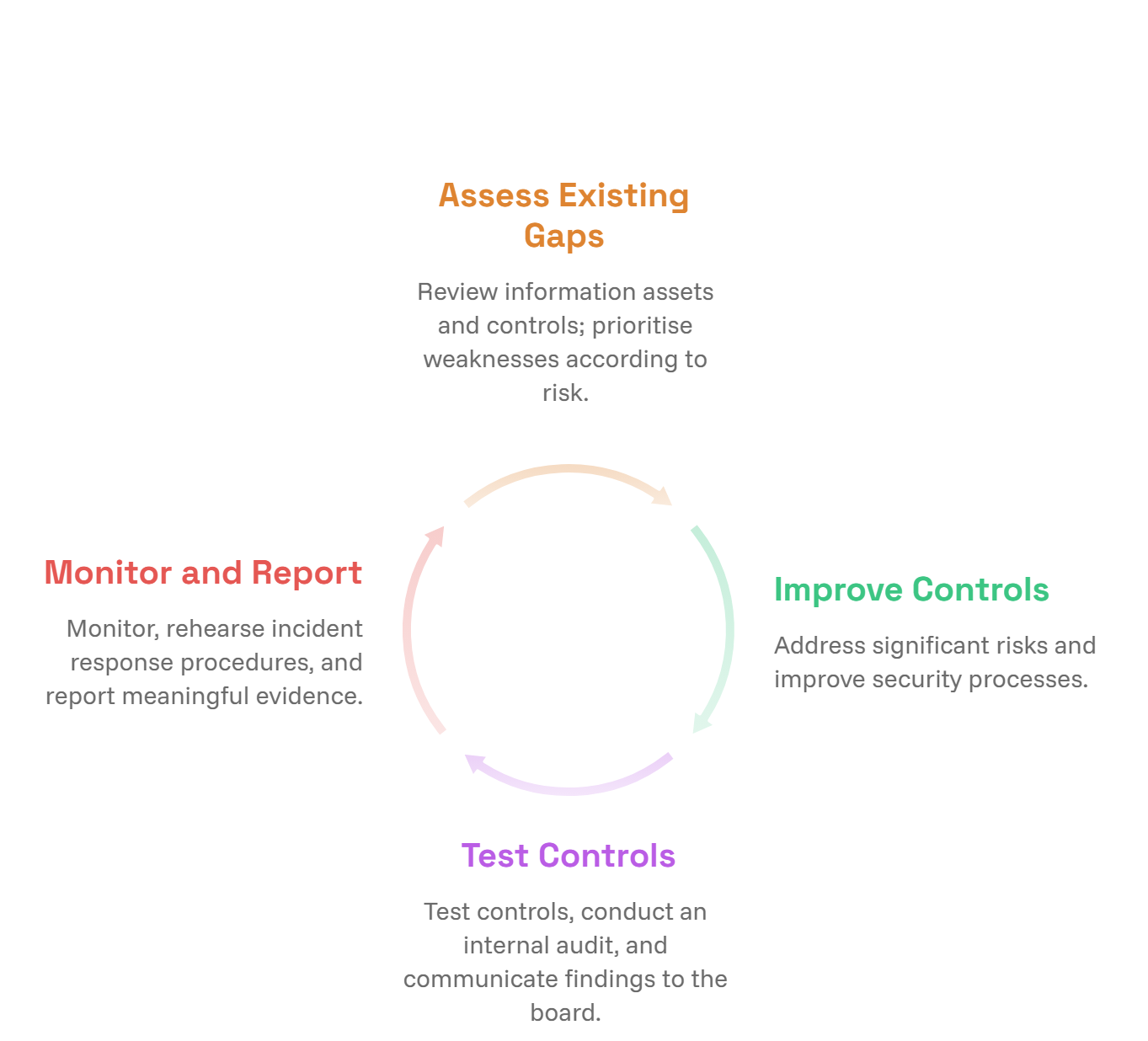
How CPS 234 Compliance Works: A Step-by-Step Approach
Step 1 — Assess Existing Gaps (Weeks 1–2)
Begin by reviewing the organisation’s information assets, asset owners, existing policies, security controls, testing records and third-party relationships against CPS 234 requirements.
This stage should also establish how the organisation determines whether an incident is material and who is responsible for making the 72-hour notification decision.
The main deliverable is an evidence-based gap assessment that identifies weaknesses and prioritises them according to risk.
Step 2 — Improve Controls and Asset Management (Weeks 3–6)
Once the gaps are understood, focus on addressing the most significant risks.
This may involve completing the information asset register, assigning missing owners, strengthening controls for critical assets and improving vendor assessments or contractual security requirements.
The objective is to improve the organisation’s actual security processes, not simply update its documentation.
Step 3 — Test Controls and Conduct an Audit (Weeks 7–8)
After implementing the required improvements, test whether the controls are working as intended.
Activities may include vulnerability assessments, penetration testing of critical systems and reviews of control effectiveness. An internal audit should also examine the results and identify any remaining weaknesses.
The findings should be documented and communicated to the board.
Step 4 — Monitor, Rehearse and Report (Ongoing)
CPS 234 compliance requires ongoing attention. Organisations should establish continuous monitoring where appropriate, schedule further testing, reassess third-party providers and rehearse incident response procedures.
Board reporting should focus on meaningful evidence, including security performance, outstanding weaknesses and remediation progress, rather than simply listing completed activities.
How Long Does CPS 234 Compliance Take and What Does It Cost in Australia?
The time and investment required for CPS 234 compliance depend on several factors, including organisational size, the number of information assets, third-party relationships, existing security maturity and the depth of testing required.
The following table provides a general planning guide. Actual timelines and costs should be confirmed after reviewing the organisation’s requirements.
| Engagement | Typical Timeline | Typical Investment Range* |
|---|---|---|
| CPS 234 gap assessment | 2–4 weeks | Lower investment, covering the assessment and a prioritised list of gaps. |
| Single-entity compliance programme | 6–12 weeks | Mid-range investment, including controls, testing and third-party activities. |
| Group or multi-entity programme | 12 weeks or more | Higher investment, reflecting multiple entities, more extensive vendor assessments and audit requirements. |
*Actual costs vary according to project scope, asset numbers, third-party relationships and the organisation’s current security maturity. Request a fixed-price assessment that includes documented evidence and clearly defined deliverables.
DevVibe follows a fixed-scope, fixed-price approach, with payments structured around three milestones: 40% at the beginning, 30% at the midpoint and 30% upon delivery.
The main cost factors include the number of information assets and service providers involved, the potential impact of a security control failure, and the amount of testing and evidence required by APRA or your clients.
Need an accurate project estimate? Discuss your requirements with DevVibe and request a budget assessment.
Green Flags to Look For
When evaluating a CPS 234 compliance provider, look for these positive indicators:
- Evidence comes first: The provider asks about your asset register, security testing records and third-party relationships before recommending a solution. They do not simply offer templates without understanding your environment.
- Clear communication with the board: They can explain CPS 234 requirements in straightforward language and help directors understand their responsibilities, risks and expected outcomes.
- Testing includes follow-up: The provider does more than conduct a scan or deliver a report. They document findings, recommend improvements and track remediation.
- Third-party risks receive proper attention: They understand the security implications of cloud platforms, outsourced services and offshore providers, and review the relevant contractual arrangements.
Red Flags to Watch For
Be cautious if a provider demonstrates any of the following:
- Promises based only on policies: A collection of documents is not enough if there is no asset register, control testing or incident response process.
- Claims that ISO 27001 completes CPS 234 compliance: ISO 27001 is a useful foundation, but it does not independently fulfil all CPS 234 requirements relating to board accountability, testing and APRA notifications.
- No practical 72-hour response plan: A provider should be able to explain how an organisation identifies a material incident, makes the reporting decision and meets the notification timeframe.
- No consideration of vendors: Ignoring third-party information assets leaves an important part of the CPS 234 programme unaddressed.
Technology, Integration, Security or Scalability Considerations
Technology and Integration for Australian Businesses
A CPS 234 programme should reflect the technology an organisation actually uses. This may include core banking or insurance platforms, cloud infrastructure, email services, identity management systems and external vendor applications.
Rather than relying on a separate demonstration environment, businesses should understand how security controls will operate across their existing systems.
Important considerations include:
- Information asset discovery: Identify relevant assets across cloud infrastructure, on-premises environments and third-party platforms. Classification should form part of this process.
- Identity and access management: Apply appropriate access controls, including least-privilege permissions and activity logging.
- Security monitoring and detection: Use monitoring solutions that can identify suspicious activity and generate alerts for people who are responsible for responding.
- Protection of test environments: Ensure that test and development environments are also considered. These environments may contain sensitive information and can have weaker security controls than production systems.
Security and Governance in Australia
Security and governance should be considered from the beginning of a CPS 234 programme rather than treated as additional tasks after implementation.
Organisations should pay attention to the following areas:
- Least-privilege access: Employees and systems should only have access to the information and resources required for their responsibilities. Broad administrative access should be limited and controlled.
- Logging and audit trails: Important activities should be recorded so they can be reviewed by authorised teams, auditors and relevant governance bodies.
- Clear accountability: The board retains responsibility for CPS 234. Management is responsible for maintaining the organisation’s security capabilities, while individuals should understand their assigned responsibilities for information assets.
- Incident notification readiness: Maintain and rehearse the 72-hour incident notification process and the 10-business-day process for material control weaknesses. Define the relevant decision-makers, APRA contact arrangements and evidence requirements.
- Alignment with Australian requirements: Consider the Privacy Act, the Australian AI Ethics Framework where AI is relevant, Essential Eight, ISO 27001 and SOC 2 readiness where appropriate, as well as CPS 230 obligations relating to operational risk and material service providers.

Scalability
Security arrangements should be designed to support future business growth.
A well-structured programme can include a version-controlled information asset register, repeatable control testing procedures and a third-party register that can be updated as new suppliers are introduced.
This approach makes it easier to expand the programme when an organisation adds another business entity, adopts new technology or begins working with additional service providers. A scalable structure also reduces the need to rebuild the compliance programme every time the business changes.
Industry Use Cases
Where CPS 234 Has the Greatest Impact in Australia
CPS 234 is particularly important for organisations that operate in regulated industries, manage sensitive customer information or depend on external providers to process and store data.
The following examples show how the standard applies across different sectors.
Banks and ADIs
Banks and credit unions hold customer deposits, financial records, and other sensitive information. CPS 234 requires them to have adequate information security capabilities, implement appropriate controls and notify APRA of material information security incidents within the required timeframe. The board must also understand the organisation’s information security risks and be able to demonstrate appropriate oversight. Responsibility cannot be treated as an IT department issue alone.
General and Life Insurers
Insurance companies manage policyholder details, claims information and, in some cases, sensitive health records. Their operations may also involve several external service providers.
CPS 234 requires insurers to identify and classify relevant information assets, test security controls and manage third-party risks across systems used for pricing, underwriting and claims processing.
Superannuation Trustees
Superannuation trustees, known as RSE licensees, manage retirement savings and related information for Australians.
CPS 234 applies to their business operations and requires appropriate security capabilities, control testing and incident notification arrangements. The board also remains accountable for overseeing information security risks.
Private Health Insurers
Private health insurers hold sensitive personal, health and claims information. Given the nature of these records, the security arrangements of these records must be compatible with the sensitive nature of the information they contain.
CPS 234 requires suitable controls, regular testing and preparation for potential information security incidents.
Vendors and Service Providers to Regulated Entities
Businesses that provide software, cloud hosting, claims processing, customer support or data analytics services to banks, insurers and superannuation funds may also encounter CPS 234 requirements through their client contracts.
Regulated organisations need to understand how their suppliers protect the information assets they manage. As a result, vendors may be asked to provide information about their asset registers, security controls, testing results and incident response arrangements before a contract is signed and during later reviews.
Service providers that can demonstrate their security capabilities are better positioned to meet client expectations and maintain these commercial relationships.
 What CPS 234 Does Not Cover
CPS 234 does not directly regulate organisations that fall outside APRA’s regulatory scope, and it does not prescribe one fixed set of security controls for every business.
It also does not replace other Australian obligations, including the Privacy Act, the Notifiable Data Breaches scheme or CPS 230.
Businesses should therefore treat CPS 234 as part of a wider regulatory and security environment. A compliance programme should work alongside other applicable obligations rather than assume that meeting CPS 234 automatically satisfies them.
Why Choose Our Services
Why Choose DevVibe for CPS 234 in Australia?
DevVibe is an Australian technology partner providing software development, AI solutions and security testing services to businesses across Australia. Its approach focuses on clearly defined project scopes, fixed pricing and delivering work that clients own.
Here are some of the key aspects of its service approach:
- Evidence-based assessments: DevVibe begins by examining the organisation’s existing security arrangements and identifying gaps that need attention. The aim is to provide a clear picture of the current position before moving into a larger programme.
- Solutions suited to your technology environment: Recommendations are developed around your existing systems, cloud platforms, vendors and information assets rather than relying on a generic demonstration.
- Governance included in the programme: Board and management responsibilities, security testing, third-party oversight and incident notification procedures are considered as part of the wider compliance work.
- Ownership of project deliverables: Clients receive their asset registers, policies, testing results and remediation plans, giving them documentation they can continue using and maintaining.
- An Australian business approach: DevVibe operates as an Australian entity, with an ABN, contracts under Australian law and invoicing in AUD. The company also emphasises direct involvement from senior engineers, from project scoping through implementation.
- Security considered throughout development: Platforms developed by DevVibe undergo an internal security review before going live. Penetration testing is also available where required.
For more information about DevVibe’s approach and why Australian businesses may consider its services for CPS 234 compliance, visit the DevVibe website or book a scoping call to request a fixed quote.
Conclusion / Call to Action
CPS 234 has been an established information security requirement for Australia’s financial services industry since 2019. In 2026, with CPS 230 operating alongside it, organisations need to look beyond written policies and demonstrate that their security arrangements are effective.
Businesses that are better prepared will be able to provide clear evidence when APRA, an auditor or a regulated client requests it. This includes a current information asset register, security testing results, third-party assessments and an incident response process that employees understand and have rehearsed.
If you want to understand how well your organisation meets CPS 234 requirements, speak with DevVibe. The team can help assess existing arrangements, identify gaps, develop practical security improvements and test relevant controls.
Contact DevVibe to discuss your CPS 234 requirements and request a fixed-scope assessment. Get a clear project scope, defined deliverables and work your organisation can own.
FAQs
Q1. What is CPS 234 in Australia?
A. CPS 234 is APRA’s Prudential Standard CPS 234 Information Security. It requires APRA-regulated organisations in Australia to maintain information security capabilities that reflect the threats to their information assets. The standard also covers responsibility assignment, asset classification, security controls, testing and notification of material incidents. It has applied since 1 July 2019.
Q2. Which providers offer incident response plan development for Australian banks and insurers?
A. Australian cybersecurity and compliance consultancies offer incident response planning, security assessments and response testing for banks and insurers. DevVibe also provides cybersecurity services to help businesses strengthen their security and incident response capabilities.
Q3. Are there managed security solutions tailored to meet CPS 234 guidelines?
A. Yes. Managed security solutions can include continuous monitoring, threat detection, vulnerability management and incident response support aligned with an organisation’s CPS 234 obligations. The solution should be tailored to the organisation’s information assets and risk profile.
Q4. What are the core principles of the Australian prudential information security standard?
A. CPS 234 focuses on maintaining appropriate information security capabilities, assigning clear responsibilities, protecting information assets, testing security controls and managing third-party risks. It also requires timely APRA notification of material security incidents and control weaknesses.
Q5. What are the key requirements of CPS 234 for Australian financial firms?
A. Key requirements include identifying and classifying information assets, implementing risk-based security controls, conducting regular testing and managing third-party security arrangements. Organisations must also maintain clear governance and meet APRA’s incident and control weakness notification deadlines.