Australia:
If your Australian business stores customer information, employee records, financial data, intellectual property, source code or confidential client information, information security needs to be more than a collection of passwords and antivirus software. Customers and larger organisations increasingly want evidence that their suppliers have a structured approach to protecting information. This is one reason many Australian businesses are exploring how to become ISO 27001 certified.
ISO/IEC 27001 is the internationally recognised standard for an Information Security Management System, commonly called an ISMS. The current international standard is ISO/IEC 27001:2022, while Australia has adopted it as AS/NZS ISO/IEC 27001:2023. Standards Australia describes the Australian version as an identical adoption of the international standard.
Getting certified is not simply about buying a template, creating a few policies and booking an audit. Your business needs to understand its information security risks, implement appropriate controls, train employees, monitor the ISMS and demonstrate that the system works in practice. This guide explains the ISO 27001 certification process in Australia, including requirements, costs, timelines, audits, controls and practical steps businesses can follow.

What Is ISO 27001 Certification?
ISO 27001 is a management-system standard designed to help organisations systematically manage information security risks. Instead of telling every company to install exactly the same software or security products, it provides a framework for understanding risks and selecting appropriate controls.
The official ISO description explains that ISO/IEC 27001 provides requirements for establishing, implementing, maintaining and continually improving an information security management system. It can be applied to organisations of different sizes and across different industries.
For an Australian business, this means ISO 27001 can be used to create a structured security program covering areas such as:
- Customer and employee information
- Business and financial records
- Cloud platforms
- Company applications
- Software source code
- Employee devices
- Third-party suppliers
- Physical documents
- Access permissions
- Security incidents
- Business continuity
- Information security risks
The important distinction is between implementing ISO 27001 and becoming ISO 27001 certified. A company can implement the standard internally without obtaining certification. Certification involves an independent certification body assessing the organisation’s ISMS against the standard.
What Does Being ISO 27001 Certified Mean?
When a business becomes ISO 27001 certified, it means an independent certification process has assessed its defined ISMS scope against the requirements of ISO/IEC 27001. It does not mean that the company can never experience a cyberattack or that every security risk has disappeared. No security standard can provide that guarantee. Instead, certification demonstrates that the organisation has established a structured approach to managing information security risks.
A certified organisation should be able to demonstrate that it:
- Understands its information security environment.
- Identifies and assesses relevant risks.
- Determines how those risks will be treated.
- Implements appropriate security controls.
- Defines responsibilities.
- Trains relevant employees.
- Monitors security performance.
- Conducts internal audits.
- Reviews the ISMS through management.
- Corrects identified problems.
- Continually improves its information security management system.
Think of ISO 27001 as a management system for security rather than a single cybersecurity product.
ISO 27001 in Australia: ISO/IEC 27001:2022 vs AS/NZS ISO/IEC 27001:2023
Australian businesses often come across two versions of the name:
- ISO/IEC 27001:2022
- AS/NZS ISO/IEC 27001:2023
This can make the certification process appear more complicated than it actually is.
Standards Australia explains that AS/NZS ISO/IEC 27001:2023 is an identical adoption of ISO/IEC 27001:2022. In practical terms, Australian organisations are working with the same international requirements while using the Australian/New Zealand designation.
This is particularly useful for Australian businesses working with international customers. Certification against the applicable Australian adoption can still align with the internationally recognised ISO/IEC 27001 framework. Businesses should also make sure they are working with the current edition rather than relying on old ISO 27001:2013 documentation.
Why Are Australian Businesses Getting ISO 27001 Certified?
The reasons vary from company to company. For some businesses, certification is driven by customer requirements. A large enterprise may ask its technology suppliers to demonstrate formal information security management before signing a contract.
For others, the motivation may come from internal risk management. If a company is growing quickly, adding employees, moving workloads to the cloud or handling increasingly sensitive customer information, informal security processes can become difficult to manage. ISO 27001 can help bring these activities into one structured system.
Common Reasons for Pursuing Certification
Australian businesses may consider certification when they want to:
- Demonstrate a formal information security management approach.
- Meet customer or procurement requirements.
- Strengthen internal security governance.
- Manage information security risks systematically.
- Improve security responsibilities across teams.
- Create documented security processes.
- Build customer confidence.
- Support international business relationships.
- Establish measurable security objectives.
- Create a framework for continual improvement.
The standard is not limited to technology companies. ISO states that organisations across different sectors and sizes can use ISO/IEC 27001.
What Are the Main ISO 27001 Requirements?
ISO 27001 contains requirements covering the establishment and operation of an Information Security Management System. Rather than looking at the standard as a giant checklist, it is easier to understand the requirements through the main areas of the ISMS.
1. Understand Your Organisation
Before implementing security controls, your organisation needs to understand its internal and external context.
This can include:
- What your business does
- What information you handle
- Your customers and suppliers
- Your technology environment
- Regulatory requirements
- Contractual obligations
- Business objectives
- Relevant information security risks
This step prevents your ISMS from becoming a generic security program copied from another organisation.
2. Define the ISMS Scope
The scope determines exactly what your ISO 27001 certification covers.
For example, the scope could involve:
- A specific SaaS platform
- A software development operation
- A corporate office
- A business division
- Cloud infrastructure
- A particular service
- Multiple locations and business functions
Scope definition is extremely important because it determines the boundaries of the certification project. A company should avoid making the scope unnecessarily broad at the beginning if a focused scope can meet its business objectives. At the same time, the scope should never deliberately exclude critical activities simply to make certification easier.
3. Establish Information Security Policies
Your organisation needs appropriate policies and documented information supporting the ISMS.
Depending on your business, this may include policies covering:
- Information security
- Access control
- Passwords and authentication
- Acceptable use
- Asset management
- Data classification
- Incident management
- Supplier security
- Backup
- Business continuity
- Remote working
- Secure development
- Employee security
The exact documentation required depends on the organisation and its risks.
4. Perform a Risk Assessment
Risk assessment is most essential parts of ISO 27001. You need to identify what could go wrong, determine the potential consequences and assess the level of risk.
For example, an Australian software company might identify risks involving:
- Compromised administrator accounts
- Cloud misconfiguration
- Vulnerable applications
- Lost employee devices
- Third-party access
- Ransomware
- Data leakage
- Weak passwords
- Unauthorised access
- Poor backup processes
Once risks are identified, the organisation determines how those risks should be treated.
What Is an ISO 27001 Risk Treatment Plan?
A risk treatment plan explains how identified information security risks will be handled.
There are several possible approaches depending on the circumstances:
- Reduce the risk: Introduce security controls.
- Avoid the risk: Stop the activity creating the risk.
- Transfer the risk: Use contractual or insurance arrangements where appropriate.
- Accept the risk: Formally accept a remaining risk based on the organisation’s criteria.
The important point is that risk decisions should be deliberate and documented.
For example, if an organisation identifies weak access control as a significant risk, its treatment could involve stronger authentication, access reviews and improved privileged-account management.
ISO 27001 Annex A Controls Explained
Annex A provides a reference set of information security controls that organisations can consider when treating their risks.
The current ISO/IEC 27001:2022 edition contains controls grouped into four themes:
| Control theme | Examples of areas covered |
|---|---|
| Organisational | Policies, supplier relationships, information security responsibilities |
| People | Employee responsibilities, awareness and security-related processes |
| Physical | Physical security and protection of equipment |
| Technological | Access control, authentication, monitoring, malware protection and technical security |
The important thing to understand is that ISO 27001 is risk-based.
You should not automatically assume that every control needs to be implemented in exactly the same way for every organisation. Your business needs to determine which controls are appropriate based on its risks and document the reasoning behind those decisions.
ISO 27001 Certification Process in Australia
The certification journey can be broken into manageable stages.
Step 1: Get Management Support
ISO 27001 should not be treated as an IT-only project. Management needs to understand why certification is being pursued, what resources are required and which parts of the business will be involved.
You may need participation from:
- IT
- Cybersecurity
- HR
- Legal
- Finance
- Operations
- Senior management
- Software development
- Procurement
Without management support, the ISMS can quickly become a document-management exercise rather than a functioning business process.
Step 2: Define Your Scope
Determine which people, locations, systems, processes and information are included. Write the scope clearly enough that an external auditor can understand exactly what is being assessed.
Step 3: Conduct a Gap Assessment
A gap assessment compares your current security practices with ISO 27001 requirements.
Typical gaps might include:
- No formal risk register
- Incomplete access reviews
- Missing security policies
- Weak supplier assessments
- No documented incident process
- Insufficient employee awareness
- Inconsistent backup testing
- Missing internal audit process
- Lack of management review
- Poor security evidence
The result should be an implementation roadmap.
Step 4: Create Your Risk Register
Identify important information assets and associated risks.
A simple risk register can contain:
| Field | Example |
|---|---|
| Asset | Customer database |
| Threat | Unauthorised access |
| Vulnerability | Excessive user permissions |
| Impact | Confidentiality breach |
| Likelihood | Medium |
| Risk level | High |
| Treatment | Access review + MFA |
| Owner | IT Manager |
| Status | In progress |
Your risk register should not be a document created once for an auditor and then forgotten. It should be updated when your business, technology or risks change.
Step 5: Implement Security Controls
This is where security becomes part of everyday operations.
Depending on your organisation, controls could involve:
- Multi-factor authentication
- Access reviews
- Privileged access management
- Encryption
- Secure backups
- Endpoint protection
- Vulnerability management
- Logging and monitoring
- Secure software development
- Incident response
- Employee security awareness
- Supplier security assessments
- Business continuity planning
Step 6: Train Employees
Employees are an important part of your information security system. Training should cover the risks employees are likely to encounter in their roles.
Topics can include:
- Phishing
- Password security
- MFA
- Social engineering
- Data handling
- Device security
- Incident reporting
- Remote working
- Safe use of company systems
Training should not be treated as a one-off checkbox.
Step 7: Collect Evidence
This is an area businesses sometimes underestimate. Having a policy is different from demonstrating that the policy is being followed.
Evidence can include:
- Access review records
- Training records
- Security logs
- Incident reports
- Backup test records
- Supplier assessments
- Risk reviews
- Internal audit reports
- Management meeting records
- Vulnerability scan results
- Corrective action records
Good evidence makes the certification audit much easier to manage.
Step 8: Conduct an Internal Audit
Before the certification audit, conduct an internal audit of your ISMS. The purpose is to identify weaknesses before the external auditor does.
An internal audit can review whether:
- Policies are implemented.
- Controls are operating.
- Employees understand their responsibilities.
- Risks are being reviewed.
- Evidence exists.
- Nonconformities are addressed.
- Objectives are being monitored.
Step 9: Conduct Management Review
Senior management should review the performance of the ISMS.
The review can consider:
- Audit findings
- Security incidents
- Risk status
- Security objectives
- Performance measurements
- Corrective actions
- Changes affecting the organisation
- Opportunities for improvement
Step 10: Complete the Certification Audit
After the ISMS has been implemented and operated, the organisation works with an independent certification body for the certification audit. The auditor evaluates the defined ISMS scope and whether the organisation meets the applicable requirements. If issues are identified, the organisation may need to address nonconformities before certification is completed.
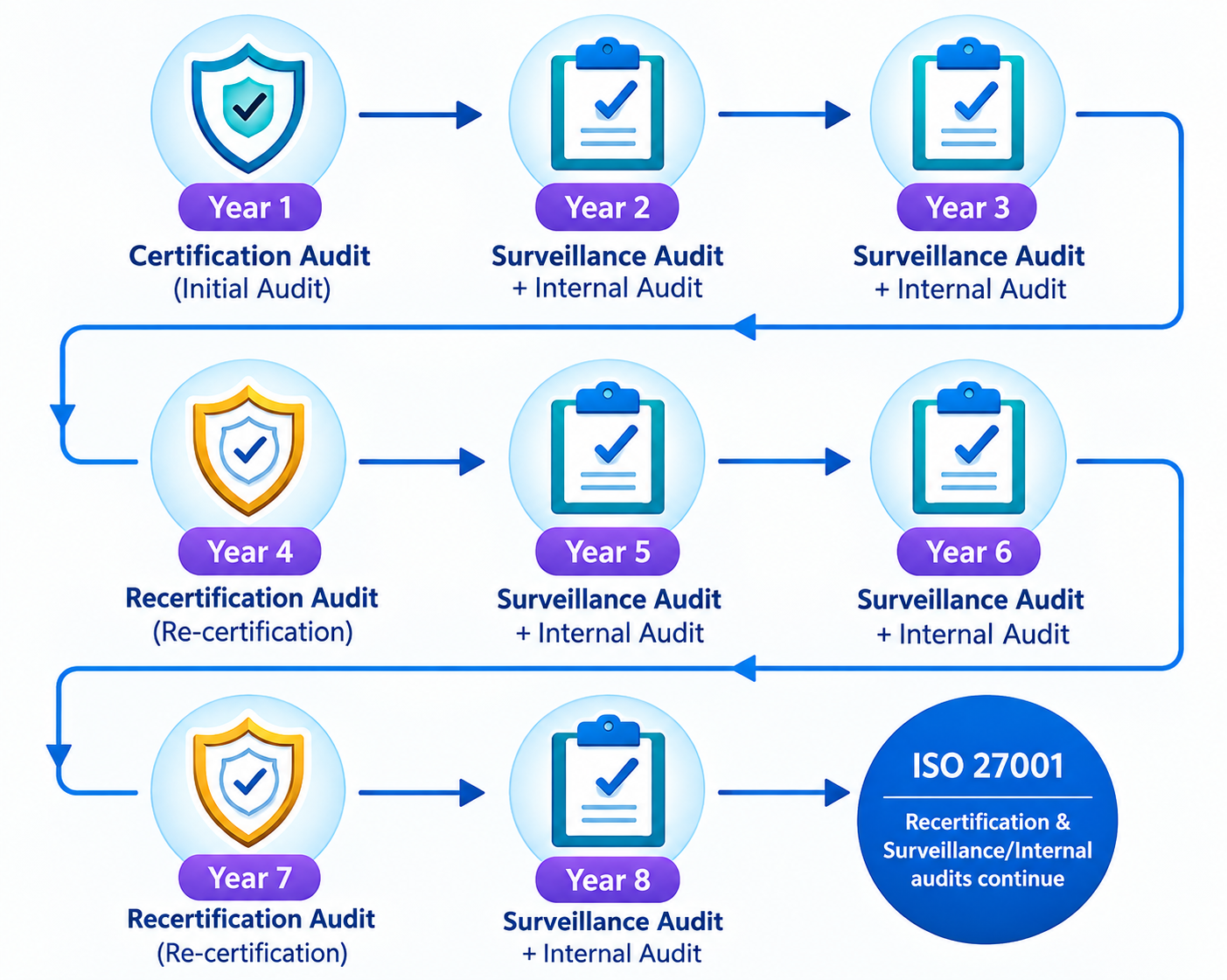
What Happens During an ISO 27001 Audit?
An ISO 27001 audit is more than checking whether documents exist. Auditors can look at whether your processes actually operate as described.
They may examine areas such as:
- ISMS scope
- Risk assessment
- Risk treatment
- Security policies
- Employee responsibilities
- Access controls
- Supplier management
- Incident management
- Internal audits
- Management reviews
- Security objectives
- Corrective actions
- Relevant technical controls
This is why businesses should avoid preparing everything immediately before the audit. A mature ISMS should already be operating before an external auditor arrives.
ISO 27001 Certification Audit Stages
The certification process generally involves different stages of assessment.
Stage 1: Documentation and Readiness
The auditor reviews the organisation’s ISMS documentation and assesses whether the organisation appears ready for the next stage.
This is an opportunity to identify major issues before the detailed assessment.
Stage 2: Implementation and Effectiveness Audit
The auditor evaluates whether the ISMS has actually been implemented and is operating effectively.
This can involve interviews, evidence reviews and assessment of relevant processes and controls.
Corrective Actions
If nonconformities are identified, the organisation needs to address them appropriately.
The response may involve:
- Fixing the immediate issue
- Identifying the underlying cause
- Implementing corrective action
- Providing evidence
- Preventing recurrence
How Much Does ISO 27001 Certification Cost in Australia?
One of the most common questions Australian businesses ask is:
How much does ISO 27001 certification cost?
There is no universal price. The total investment can vary significantly depending on the size and complexity of the organisation.
Factors include:
- Number of employees
- Number of locations
- ISMS scope
- Existing security maturity
- Number of systems
- Cloud infrastructure
- Supplier relationships
- Number of business processes
- Internal staff resources
- Consultancy requirements
- Certification audit fees
- Security technology improvements
- Remediation work
Main ISO 27001 Cost Categories
| Cost category | What you may pay for |
|---|---|
| Gap assessment | Identifying current security gaps |
| Consultancy | Implementation and compliance support |
| Staff time | Internal project management and implementation |
| Security technology | MFA, monitoring, backup, access controls and other tools |
| Training | Employee security awareness |
| Internal audit | Independent readiness assessment |
| Certification audit | External certification assessment |
| Remediation | Correcting identified weaknesses |
| Ongoing maintenance | Surveillance, reviews and continual improvement |
For this reason, businesses should be careful with websites advertising one fixed “ISO 27001 certification price”. The certification audit is only one part of the overall project.
How Long Does ISO 27001 Certification Take?
There is also no universal certification timeline. A small Australian technology company with mature security processes may have a very different starting point from a larger organisation that has never formalised information security management.
Your timeline can be affected by:
- Business size
- ISMS scope
- Number of employees
- Number of locations
- Existing policies
- Security maturity
- Technical gaps
- Supplier complexity
- Internal resources
- Audit availability
A practical project should allow enough time for controls to operate and produce evidence. Trying to complete everything in a rush can create unnecessary problems during the audit.
ISO 27001 vs Essential Eight in Australia
Australian businesses often encounter the Essential Eight when researching cybersecurity. ISO 27001 provides a broader information security management system, covering governance, risk management, people, processes and technology. The Essential Eight focuses on a defined set of cybersecurity mitigation strategies. They can therefore be used together.
For example, an organisation could implement technical security measures such as stronger authentication, application control, patching and backups while using ISO 27001 to create the wider management framework around information security risks.
ISO 27001 and Australian Privacy Requirements
If your organisation handles personal information, privacy should also be considered during your information security planning. Australian organisations may have obligations under the Privacy Act 1988 and Australian Privacy Principles depending on their circumstances. This privacy law is not to be supplanted by ISO 27001 in Australia. Alternatively, an ISMS can offer a methodical strategy for detecting and controlling threats to the security of sensitive data.
For example, your organisation can consider:
- Where personal information is stored
- Who can access it
- Why it is collected
- Which suppliers process it
- How it is protected
- How incidents are handled
- How information is retained and disposed of
The important lesson is simple: ISO 27001 certification should complement your legal and contractual obligations rather than being treated as a replacement for them.
What Documents Do You Need for ISO 27001?
Your company and the specifics of your ISMS’s design will determine the documentation needs.
Typical documentation may include:
- ISMS scope
- Information security policy
- Risk assessment methodology
- Risk register
- Risk treatment plan
- Statement of Applicability
- Security objectives
- Access-control procedures
- Incident-management procedures
- Supplier-security processes
- Internal audit records
- Management review records
- Corrective action records
- Evidence of employee awareness and training
Do not create documentation simply because a template says you should. The documentation needs to reflect how your organisation actually operates.
What Is the Statement of Applicability?
The Statement of Applicability, often called the SoA, is an important part of ISO 27001 implementation.It documents the security controls relevant to your organisation and provides the rationale for their inclusion or exclusion. It connects your risk assessment and risk treatment decisions with the controls your organisation has selected.
In simple terms, it helps answer:
“Which security controls apply to our organisation, and why?”
That makes the SoA an important document for understanding the logic behind your security program.
Common ISO 27001 Mistakes Australian Businesses Should Avoid
Treating ISO 27001 as an IT Project
Information security involves the entire organisation. HR, management, finance, operations, procurement and employees can all affect information security.
Creating Policies Nobody Uses
A beautifully written security policy is not useful if employees do not follow it. Your documentation should describe real processes.
Ignoring Third-Party Risk
Australian businesses increasingly rely on cloud platforms, SaaS applications, developers, consultants and other suppliers. Those connections need to be thought about when evaluating potential threats to data security.
Leaving the Internal Audit Until the Last Minute
An internal audit should be used to discover problems while there is still time to correct them.
Failing to Keep Evidence
If a control is operating but there is no reliable evidence, demonstrating effectiveness during an audit can become difficult.
Choosing the Cheapest Certification Quote
Price is only one consideration. Businesses should understand exactly what the certification proposal includes, the audit scope, audit days, follow-up arrangements and ongoing surveillance requirements.
How Can Technology Support ISO 27001?
Technology does not replace an ISMS, but it can support many of the controls and processes within one.
For example, businesses can use technology to improve:
- Identity and access management
- Security monitoring
- Vulnerability management
- Backup
- Encryption
- Endpoint protection
- Application security
- Cloud security
- Audit logging
- Incident response
- Secure software development
This becomes especially important for Australian businesses operating SaaS platforms, web applications, mobile applications and cloud-based services.
If you’re developing or modernising business software, secure development should be considered from the beginning rather than added just before an ISO audit.
How DevVibe Can Help Australian Businesses
DevVibe Australia works with Australian businesses on software, AI and technology development. Its services include AI development, custom software development and technology solutions for businesses operating across Australia.
For companies building applications or digital platforms as part of their wider information security program, technical security should be considered alongside governance and risk management.
You can explore DevVibe’s AI development services in Australia if your organisation is building AI-powered applications or automation systems.
You can also learn more about custom software development in Australia if your business needs software designed around its operational and security requirements.
DevVibe also publishes practical cybersecurity and technology content for Australian businesses, including its guide on machine learning and cybersecurity in Australia.
How to Prepare for ISO 27001 Certification: Practical Checklist
Before contacting a certification body, work through this checklist:
- Define your ISMS scope.
- Obtain management support.
- Identify important information assets.
- Identify relevant information security risks.
- Establish a risk assessment methodology.
- Create a risk register.
- Develop a risk treatment plan.
- Determine applicable controls.
- Create the Statement of Applicability.
- Implement required controls.
- Train employees.
- Establish incident-management procedures.
- Review supplier risks.
- Collect evidence.
- Conduct an internal audit.
- Complete a management review.
- Correct identified issues.
- Select an appropriate certification body.
- Complete the certification audit.
- Maintain the ISMS after certification.
How to Choose an ISO 27001 Certification Body in Australia
An independent certification authority should do the certification. Beyond the headline price, consider other factors when comparing providers.
Consider:
- Accreditation
- Relevant ISO 27001 experience
- Auditor experience
- Audit scope
- Audit duration
- Surveillance arrangements
- Follow-up processes
- Industry experience
- Communication before the audit
Standards Australia provides information about Australian Standards and the organisations involved in standards and conformity assessment. Before committing to a certification, businesses should examine the organization’s background and responsibilities.
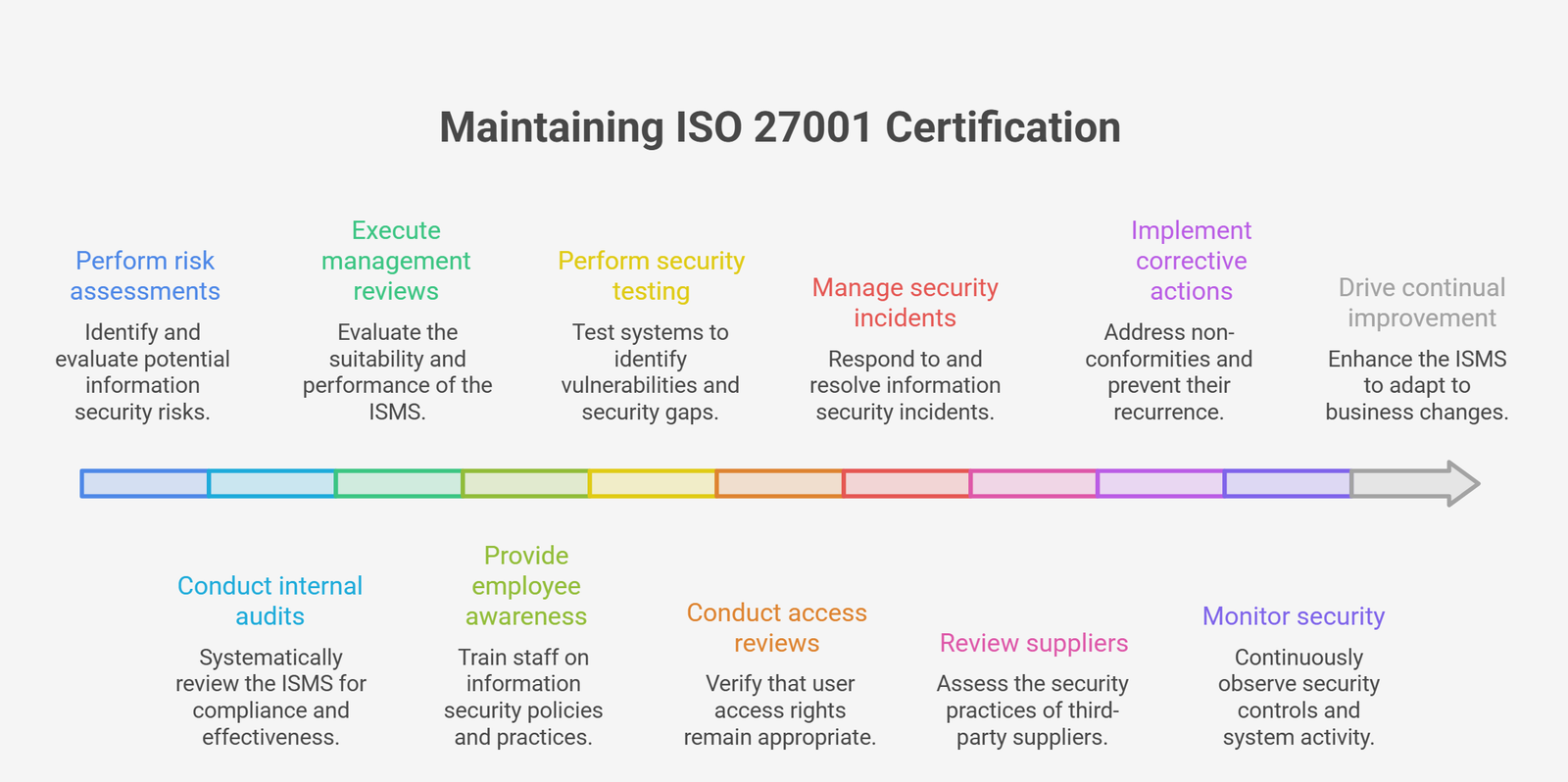
What Happens After You Become ISO 27001 Certified?
Certification is not the finish line. Your ISMS needs to remain operational and improve over time.
After certification, organisations should continue activities such as:
- Risk assessments
- Internal audits
- Management reviews
- Employee awareness
- Security testing
- Access reviews
- Incident management
- Supplier reviews
- Corrective actions
- Security monitoring
- Continual improvement
Your business will change.
You may introduce new cloud services, hire employees, launch applications, change suppliers or enter new markets. New information security threats might be introduced with each update.
The focus of ISO 27001 is on ongoing improvement rather than a final certification project because of this.
Final Thoughts
Getting ISO 27001 certified in Australia requires more than preparing documentation for an auditor. The real objective is to establish an information security management system that fits your organisation, manages meaningful risks and continues operating as your business evolves.
The process normally starts with defining your scope and understanding your information security environment. From there, you identify risks, establish a treatment plan, implement appropriate controls, train employees, collect evidence, conduct an internal audit and management review, and then complete the independent certification process.
The cost and timeline will depend heavily on your organisation’s size, scope and existing security maturity. A small business with established security processes may have a very different project from a large organisation with multiple locations, complex suppliers and extensive cloud infrastructure.
Most importantly, don’t treat the certificate as the end goal. A well-designed ISMS should help your organisation make better security decisions throughout the year, not just during an audit.
For Australian businesses, ISO 27001 certification can become part of a broader information security strategy that brings people, processes, risk management and technology together in one structured framework.
Need Help Preparing for ISO 27001 Certification?
Getting ISO 27001 certified involves more than preparing documents. Your business needs a practical information security management system, risk assessment, appropriate security controls, internal reviews and ongoing improvement.
If you are preparing your Australian business for ISO 27001 certification, DevVibe can help you strengthen the technology and security foundations behind your ISMS.
How DevVibe Can Help
- Cybersecurity assessment to identify security weaknesses and risks
- Custom software security for business applications and internal systems
- Cloud and infrastructure security improvements
- Security-focused development for new and existing applications
- AI and automation solutions designed with security considerations
- Technical guidance to help your team prepare for security requirements
Ready to strengthen your organisation’s security before certification? Talk to a DevVibe Security Expert
Frequently Asked Questions
Is ISO 27001 certification mandatory in Australia?
ISO 27001 certification is not universally mandatory for Australian businesses. Organisations can implement the standard without obtaining formal certification. However, specific customers, contracts, procurement requirements or industry expectations may require ISO 27001 certification or comparable evidence of information security management.
How much does ISO 27001 certification cost in Australia?
There is no fixed Australian price. Costs depend on the organisation’s size, ISMS scope, existing security maturity, number of locations, technical environment, consultancy requirements and certification audit fees.
How long does ISO 27001 certification take?
The timeline depends on the organisation’s starting point. Businesses with mature security processes may require less preparation than organisations building an ISMS from scratch. Scope and organisational complexity also have a significant effect.
Can a small Australian business become ISO 27001 certified?
Yes. ISO/IEC 27001 is designed to be applicable to organisations of different sizes and sectors. The key is creating an ISMS appropriate to the organisation’s actual risks and business context.
Is ISO 27001 the same as the Australian ISO 27001 standard?
AS/NZS ISO/IEC 27001:2023 is Australia’s identical adoption of ISO/IEC 27001:2022. Australian businesses may therefore encounter both designations when researching the standard